
Portfolio Project · Full Digital Marketing Strategy · Gaming E-commerce
From Market Gap to Full Campaigns: Building a Gaming Eyewear Brand from the Ground Up
A complete digital marketing portfolio project spanning competitive research, brand strategy, SEO, email marketing, paid advertising, and analytics, built to demonstrate end-to-end strategic and executional capability across the full marketing funnel.
Blue Light Defenders is a fictional brand created for portfolio demonstration purposes. All strategies, deliverables, and creative assets are genuine professional-grade work. Performance metrics are clearly labeled as projections or simulations throughout the case study.
Some of The Best Ad Creatives






About The Project
Blue Light Defenders is a portfolio project created to demonstrate end-to-end digital marketing capability. The brand, products, and business scenario are fictional. All strategies, frameworks, creative assets, and analytical work are genuine professional-grade deliverables built using real industry tools. Campaign performance metrics represent strategic projections and simulated scenarios, clearly labeled in each relevant section. Google Analytics 4 work uses Google’s publicly available Merchandise Store demo property, a standard industry practice for developing and demonstrating analytics skills.
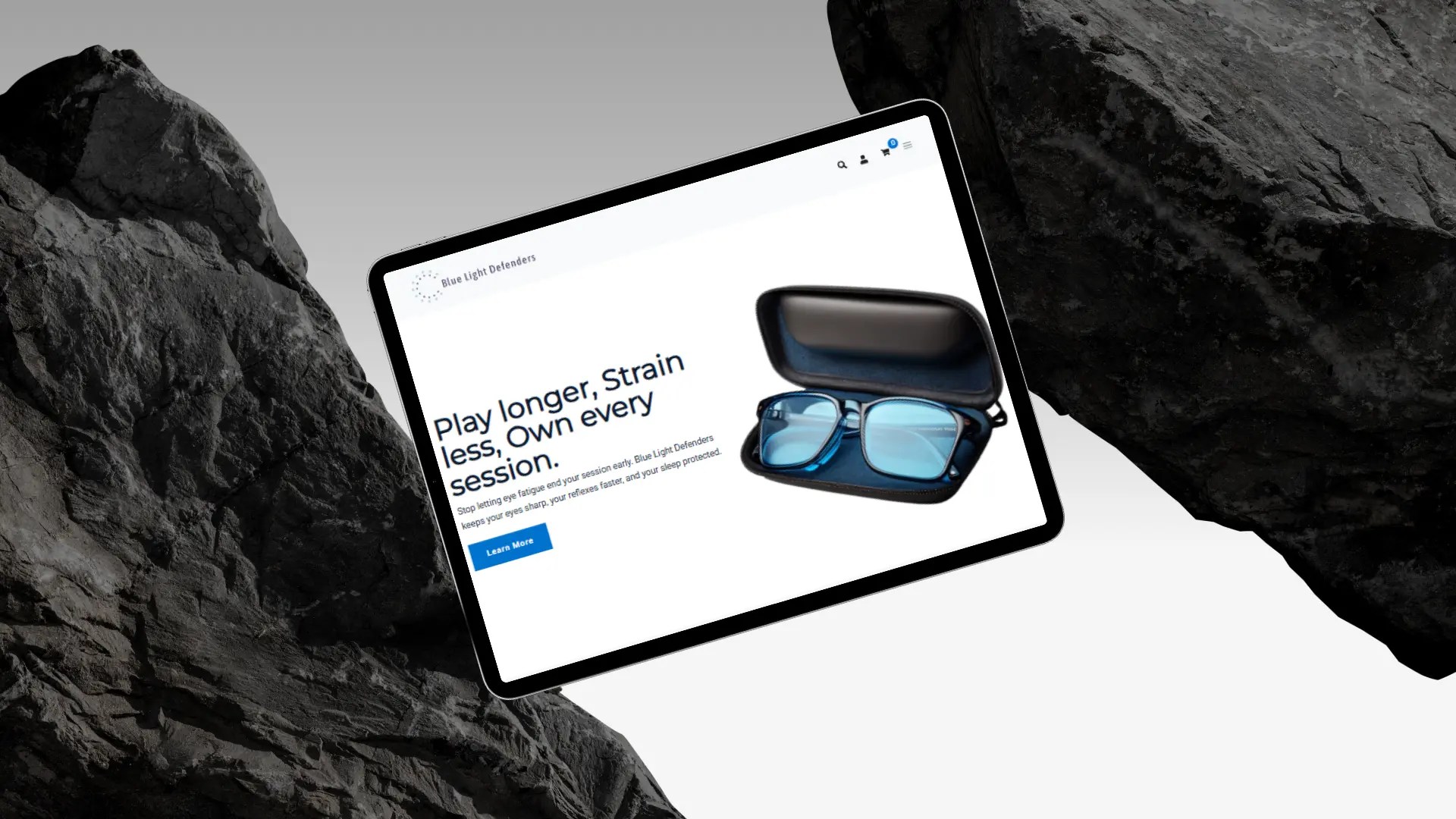
Project Overview
The gaming eyewear market had a problem that most brands were not talking about. The dominant players, GUNNAR, Gamer Advantage, and a handful of wellness-adjacent alternatives, had effectively priced out the majority of their potential audience. Their products started at sixty dollars and climbed well past one hundred. Their messaging leaned clinical and health-conscious. And the people they were trying to reach, competitive gamers who spent six to ten hours a day in front of high-brightness screens, were not responding, because gamers do not buy health products. They buy performance gear.
Blue Light Defenders was built as a strategic response to that gap. This portfolio project simulates a complete digital marketing engagement from first principles: a competitive market analysis that identified the opportunity, a customer persona built from behavioral research rather than demographics, a brand strategy grounded in performance positioning rather than wellness messaging, and a full campaign execution across five channels, SEO, email marketing, Google Ads, social media advertising, and analytics optimization, all developed using professional industry tools.
The project was built around two clearly defined goals: establish brand awareness among performance-driven gamers aged twenty-three to thirty-three across the US, UK, Canada, Australia, and Germany, and increase holiday online sales by three percent. Every strategic decision, creative asset, and analytical exercise documented in this case study traces back to those two objectives.
What follows is a complete record of how that strategy was developed, how the campaigns were structured, what the data showed, and what was learned. It is not a record of a live business operation, it is a demonstration of how I think, how I work, and what I know how to build.
The Problem & Market Opportunity
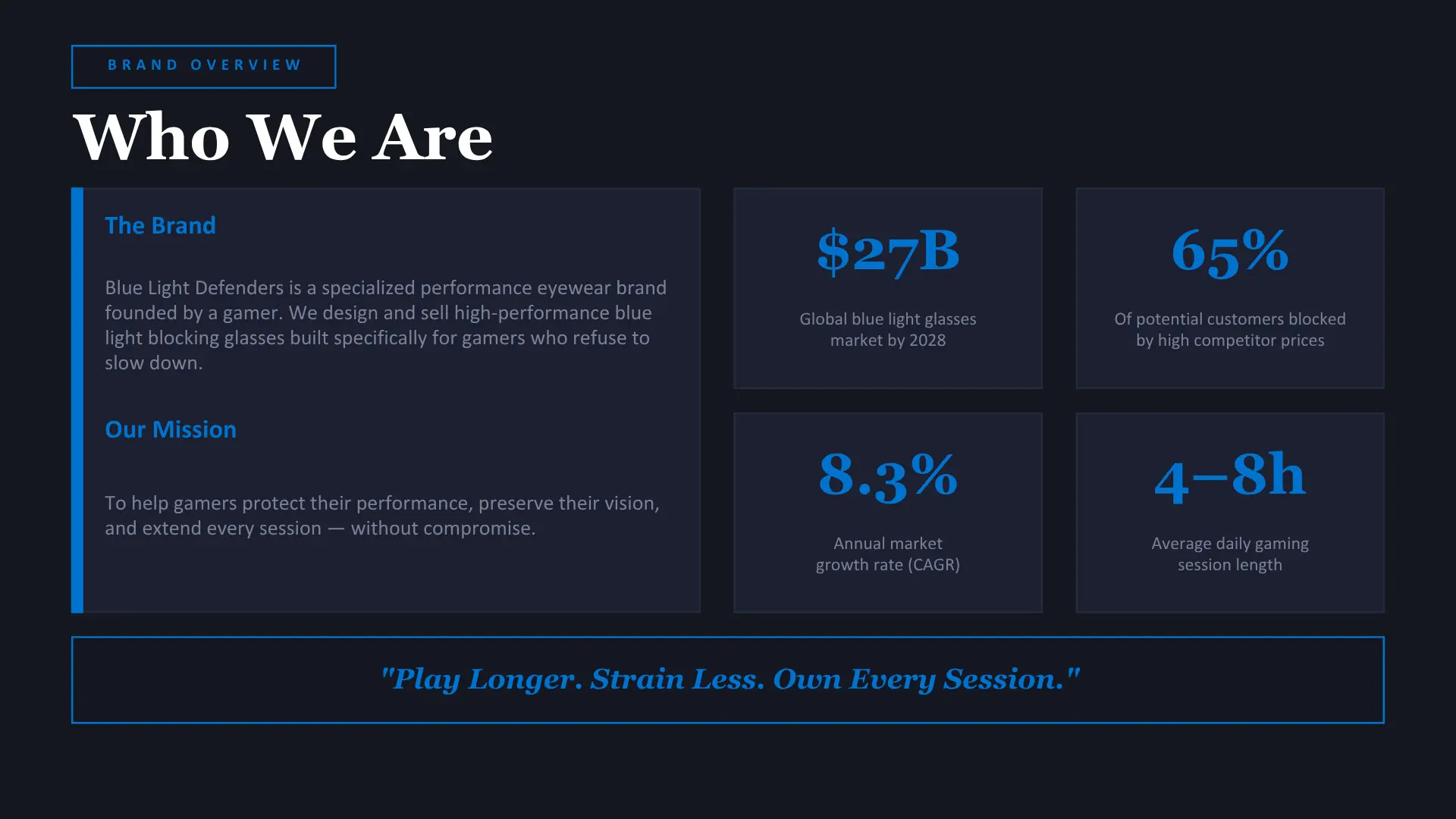
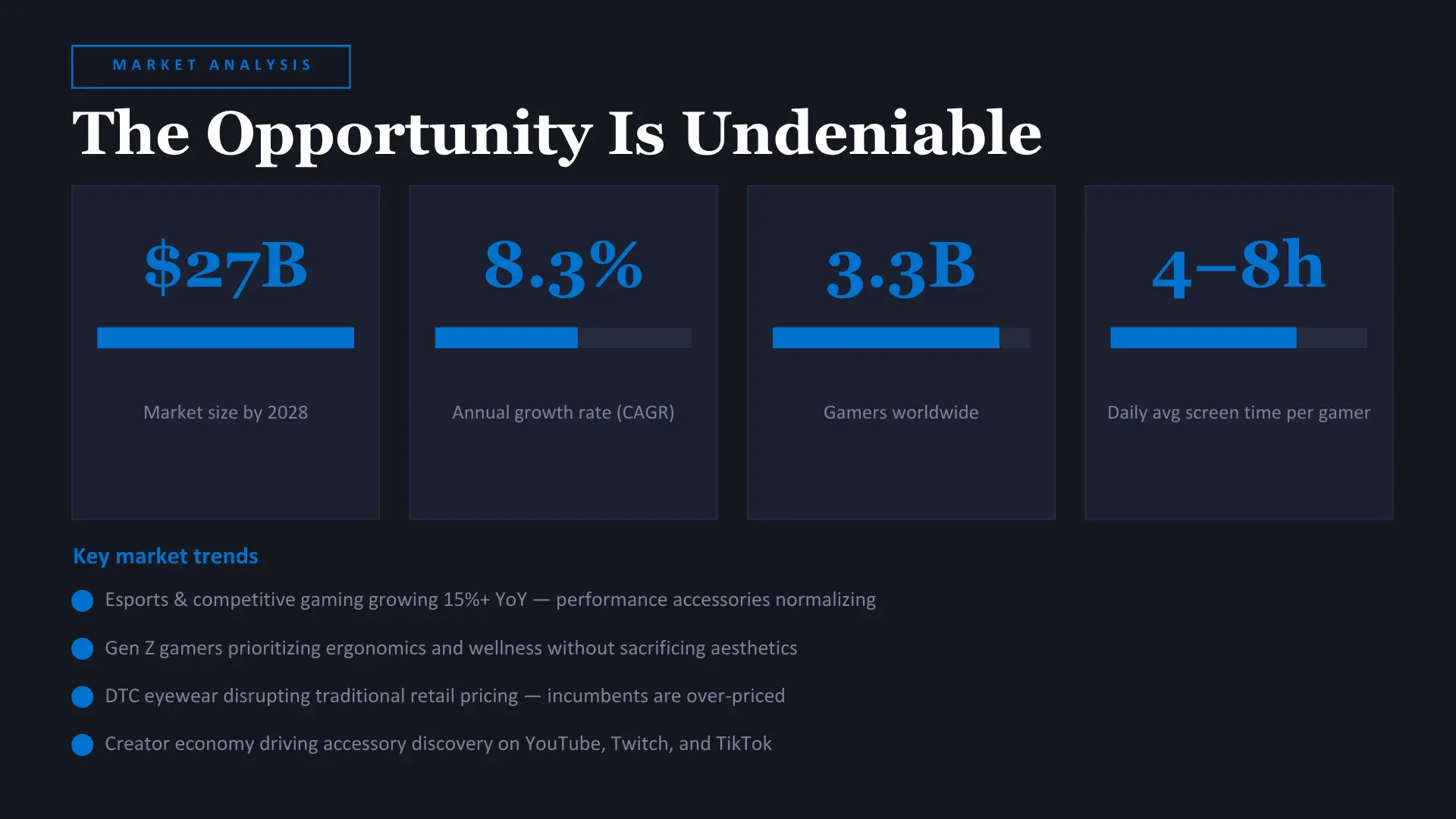
By the mid-2020s, the blue light blocking glasses market had consolidated around a familiar pattern. A small number of premium brands had claimed the high end of the market with products priced between sixty and two hundred and fifty dollars, clinical-sounding messaging built around lens technology and eye health research, and distribution through specialty retailers and direct-to-consumer websites. The category was growing, projected to reach twenty-seven billion dollars globally by 2028 at an annual growth rate of 8.3 percent, and the established players were growing with it.
The problem was not the growth. The problem was who was being left out of it.
Internal research and competitive analysis revealed that sixty-five percent of potential customers cited price as their primary barrier to purchasing blue light protection. Not skepticism about whether the product worked. Not brand preference for a competitor. Price. The majority of the market, the gamers, the students, the remote workers, the people spending the most hours in front of the brightest screens, was effectively shut out by the pricing structure of the brands that were supposed to serve them.
The messaging problem ran equally deep. The dominant brands spoke the language of optometry and wellness. Their copy referenced clinical studies, lens technology specifications, and eye health outcomes. For a thirty-year-old competitive gamer who normalizes six-hour sessions, runs on energy drinks, and identifies as someone who takes their performance seriously, not their eye health, that language landed somewhere between irrelevant and condescending. It was the language of a doctor’s waiting room applied to a product that belonged in a battlestation setup.
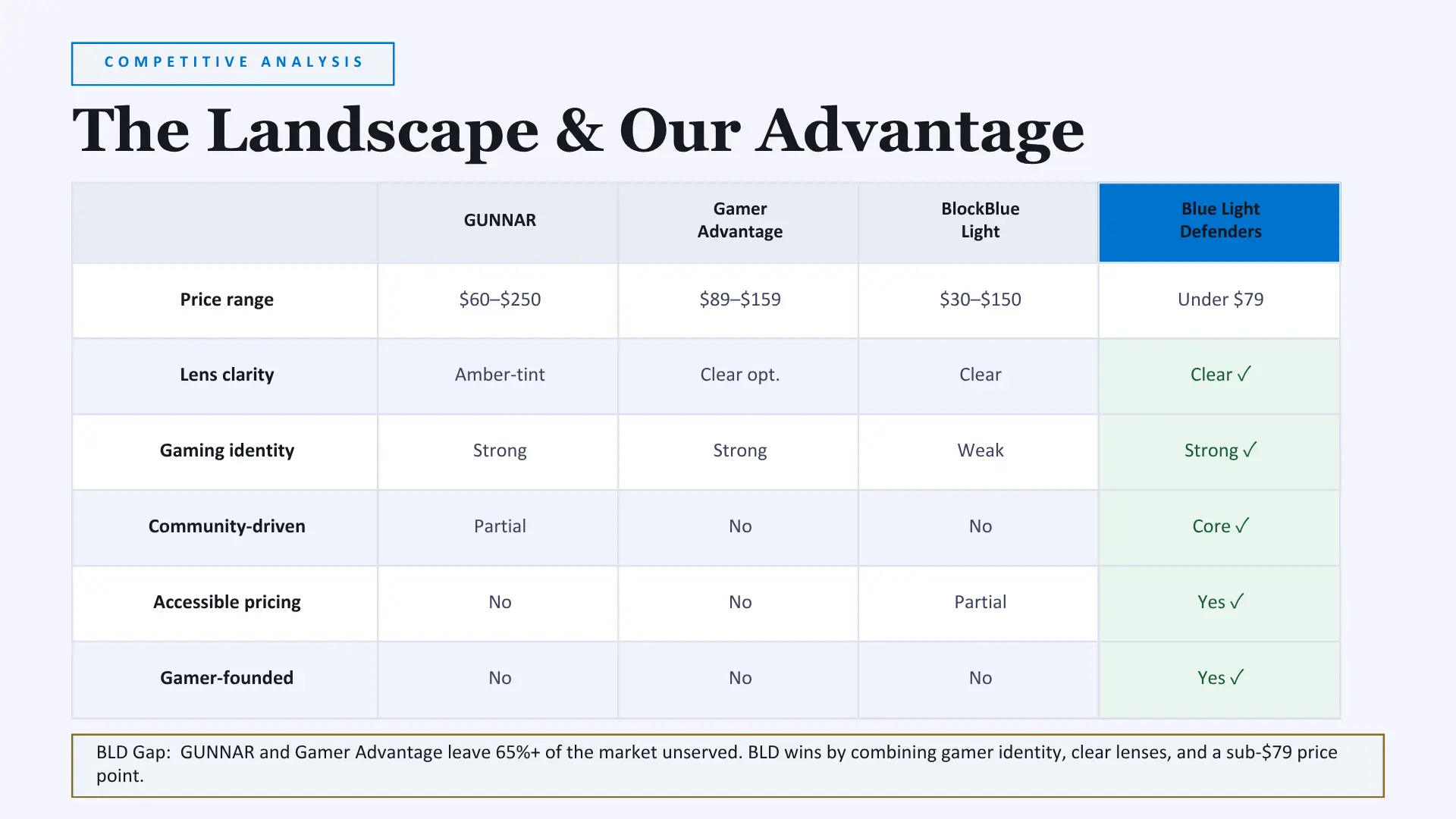
The opportunity that emerged from this analysis was precise. It was not simply “make a cheaper version of what already exists.” It was something more specific: build a brand that speaks to performance-driven gamers in their own language, at a price point that does not require them to choose between good gear and a full month’s gaming budget, with a product differentiator, clear lenses rather than the amber tint that GUNNAR had made standard, that addressed a complaint the gaming community had been voicing for years. Amber lenses distort screen colors. For competitive players who depend on visual accuracy, that distortion is not a minor inconvenience. It is a reason to put the glasses back in the box.
Blue Light Defenders was positioned to own that space. What the strategy needed to determine was whether the space was real, who exactly lived in it, and how to reach them in a way that would earn their trust rather than their skepticism.
Three questions followed from this analysis: Who exactly is the person this brand needs to reach? What does the world look like from inside their experience? And what would it take for them to trust a brand they have never heard of? The research phase was built to answer all three.
Research & Discovery
Understanding the Market Before Making a Single Recommendation
Every strategic decision in this project traces back to something discovered before the strategy existed. The research phase was not a formality conducted to justify conclusions that had already been reached, it was the process through which the conclusions became possible. Three distinct research streams ran simultaneously: a structured competitive analysis of the existing market landscape, a deep audience research process that produced a single, detailed customer persona, and a social listening exercise that revealed what the target audience was already saying about the category before any brand tried to influence them.
Competitive Intelligence
What the Existing Market Revealed
Four brands were analyzed in depth: GUNNAR, Gamer Advantage, BlockBlueLight, and a mapping of where Blue Light Defenders would need to position itself relative to all three. The analysis went beyond pricing and product comparison, it examined content strategy, social media presence, email acquisition tactics, customer review patterns, brand tone of voice, and the specific language each competitor used to describe their products and their audience.
Two findings emerged that shaped the entire subsequent strategy. The first was the pricing gap already identified in the market analysis, but the competitive research made it more specific. GUNNAR’s most accessible product started at sixty dollars. Gamer Advantage entered at eighty-nine. Neither brand offered anything under that threshold that carried meaningful gaming credibility. The gap below seventy-nine dollars was not occupied by a single brand with strong gaming identity, clear lens technology, and genuine community presence. That gap was the opportunity.
The second finding was more nuanced and ultimately more valuable. GUNNAR, the market leader, had built its entire product line around amber-tinted lenses. The amber tint blocks more blue light than clear lenses, and GUNNAR’s marketing leaned into this as a technical advantage. But the gaming community had a persistent, well-documented complaint about amber lenses that GUNNAR’s marketing consistently sidestepped: they distort screen colors. For a casual gamer watching a film or browsing social media, color distortion is a minor inconvenience. For a competitive player where enemy visibility, map color-coding, and split-second visual discrimination determine outcomes, it is a genuine problem. The competitive analysis identified clear lenses, with strong but accurate blue light filtering, as the single most powerful product differentiator available to a new entrant in this market.
Audience Research
The Person at the Center of Every Decision
Before building anything, before writing a headline, choosing a color, or selecting a keyword, a single question needed a precise answer: who, specifically, is the person this brand exists to serve?
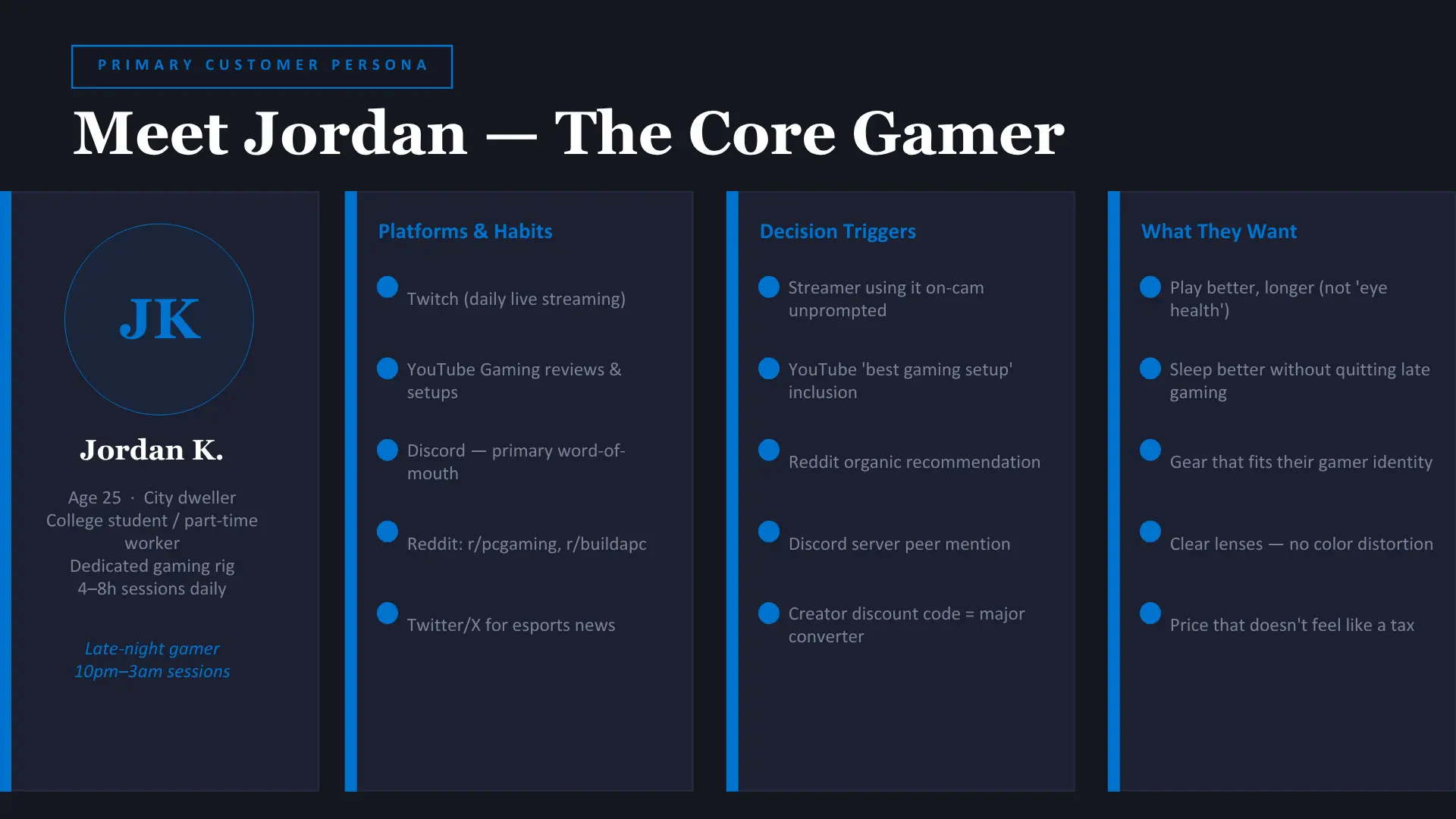
His name, for the purposes of this project, is Jordan K. He is twenty-five years old, lives alone, works part-time, and games competitively for somewhere between six and ten hours every day. His setup is deliberate, multiple monitors, high refresh rate displays, a dark room that amplifies the contrast between his screens and his environment. He has a ranking to protect and a community on Discord and Twitch that he is genuinely embedded in. He is not playing casually. He is playing to win.
Jordan’s eyes start to burn around hour three. By hour five, his reaction time has degraded enough that he can feel it. Not dramatically, not in a way he would describe to a doctor, but enough that he notices the drop in his own performance. He does not frame this as an eye health problem. He frames it as a performance problem. And that distinction is the most important strategic insight in this entire project.
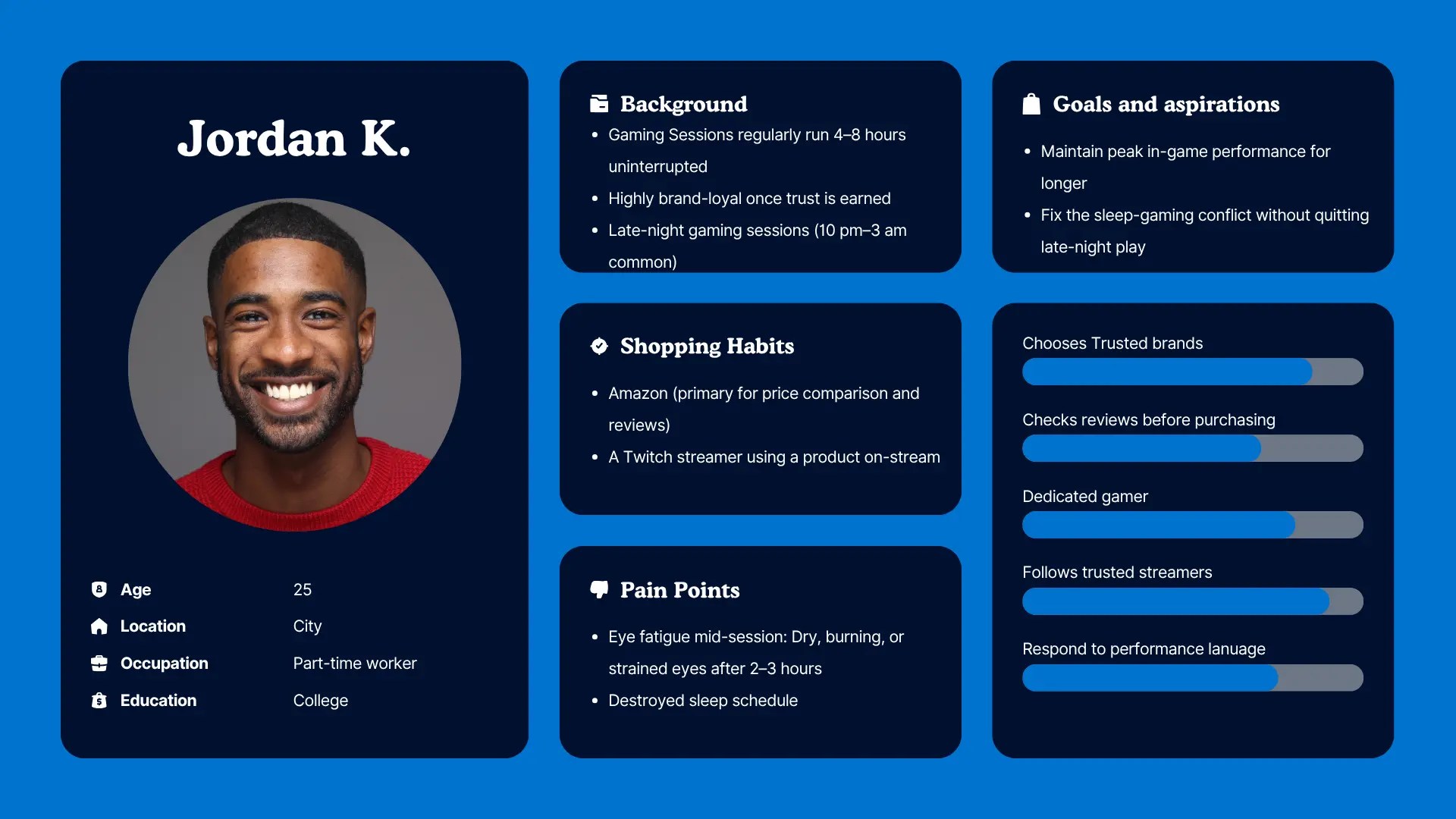
He is deeply skeptical of wellness products. He has watched too many sponsored segments on Twitch where streamers read their discount codes with the energy of someone who has never used the product they are endorsing. He does not buy things because an advertisement told him they were good. He buys things because a streamer he trusts used them unprompted on a stream, or because three separate people in his Discord server recommended them independently, or because a Reddit thread with no apparent financial incentive came to an unambiguous conclusion. Trust, for Jordan, is earned through community consensus, not through marketing claims.
When he does buy, he researches. He opens multiple tabs. He reads the one-star reviews first, because that is where the honest information lives. He compares against competitors by name, searching “GUNNAR versus” and reading through the results. He has a rough price ceiling in his head, somewhere around seventy to one hundred dollars for gaming accessories, and he applies it more strictly to unfamiliar brands than to ones he already trusts. He is not cheap. He is careful. There is a difference.
Every creative decision in this project was made with Jordan in this room, at this desk, with these habits and these doubts. When the headline says “Play Longer. Strain Less.” rather than “Protect Your Eye Health,” that is because Jordan would close the tab on the second version. When the ad creative uses a dark keyboard background rather than a clean white product shot, that is because Jordan’s world is dark rooms and glowing screens, not photography studios. When the email sequence leads with empathy rather than a discount, that is because Jordan has been pitched too many times and needs to feel understood before he will consider being sold to. The persona is not a marketing document. It is a decision-making filter applied to every subsequent choice in the project.
Social Listening
What the Audience Was Already Saying
Before any brand messaging was developed, a social listening exercise was conducted across the channels where the target audience was most active, Reddit communities including r/pcgaming and r/buildapc, Discord gaming servers, X (formerly Twitter) gaming conversations, and YouTube comment sections on gaming peripheral review videos. The goal was to hear what gamers were saying about eye strain, blue light glasses, and the existing brands in the category, without any brand influence in the room.
Three patterns emerged consistently. Positive mentions of blue light glasses in gaming communities almost always framed the benefit in performance terms: longer sessions, less fatigue, staying sharper later into the night. Negative mentions almost always centered on one of two complaints: color distortion from amber lenses, or the price of the products that were widely considered credible. And purchase decisions the moments where community members revealed what had actually convinced them to buy, consistently traced back to an organic community mention rather than a paid advertisement. A streamer who wore a pair without mentioning a sponsorship. A Reddit thread where multiple independent voices reached the same conclusion. A Discord recommendation from someone whose gaming judgment the buyer already respected.
These three findings did not suggest a marketing strategy. They confirmed one that was already taking shape from the competitive and audience research. Performance language over wellness language. Clear lenses as the lead differentiator. Community channels as the primary trust-building environment. Each finding from the social listening exercise reinforced a direction that the other research streams had already pointed toward, which is the strongest form of strategic validation available before a campaign launches.
Community Trust Drives Purchase
Performance Language Wins
Clear Lenses Are the Gap
The research phase produced something more valuable than data. It produced a point of view, a specific, defensible perspective on who the audience was, what they needed, and why existing brands were failing to give it to them. The next step was to translate that point of view into a brand strategy precise enough to guide every creative decision that followed.
Brand Strategy & Positioning
Building the Brand Before Building the Campaigns
A brand strategy is not a mood board, and it is not a logo. It is a set of decisions, made before any creative work begins, about who the brand is, who it exists to serve, why those people should choose it over every available alternative, and how it should speak in every environment it appears in. Without those decisions locked in first, every subsequent creative choice becomes a matter of personal preference rather than strategic intent. With them in place, even the smallest decisions, a headline word, a button color, an email subject line, have a source they can be traced back to.
The brand strategy for Blue Light Defenders was developed in four stages: a positioning statement that defined the brand’s place in the market, an archetype framework that defined its personality, a messaging framework that translated the positioning into operational language, and a visual identity direction that ensured the brand looked like it belonged in the world it was trying to enter. Each stage informed the one that followed it. None of them were decorative.
Positioning
The Single Most Important Strategic Decision in the Project
A positioning statement is not marketing copy. It is an internal declaration, a precise articulation of who the brand serves, what it delivers, and why it is different from everything else available. It does not need to be beautiful. It needs to be exact. Every headline, every ad, every email subject line written after it exists in relationship to it, either expressing it or testing against it.
“For performance-driven gamers aged sixteen to thirty-five who demand more from every session, Blue Light Defenders delivers gamer-native blue light protection that extends playtime, sharpens focus, and preserves sleep, at a price that doesn’t punish commitment.”
Every word in this statement was chosen deliberately. “Performance-driven” rather than “health-conscious”. Because the audience self-identifies through performance, not wellness. “Gamer-native” rather than “designed for gamers”. Because the brand needed to feel like it came from inside gaming culture, not like it had been designed for it by an outside observer. “Doesn’t punish commitment” rather than “affordable”. Because affordability implies compromise, and the positioning required accessible pricing without sacrificing the signal of quality.
Brand Personality
The Hero and The Outlaw
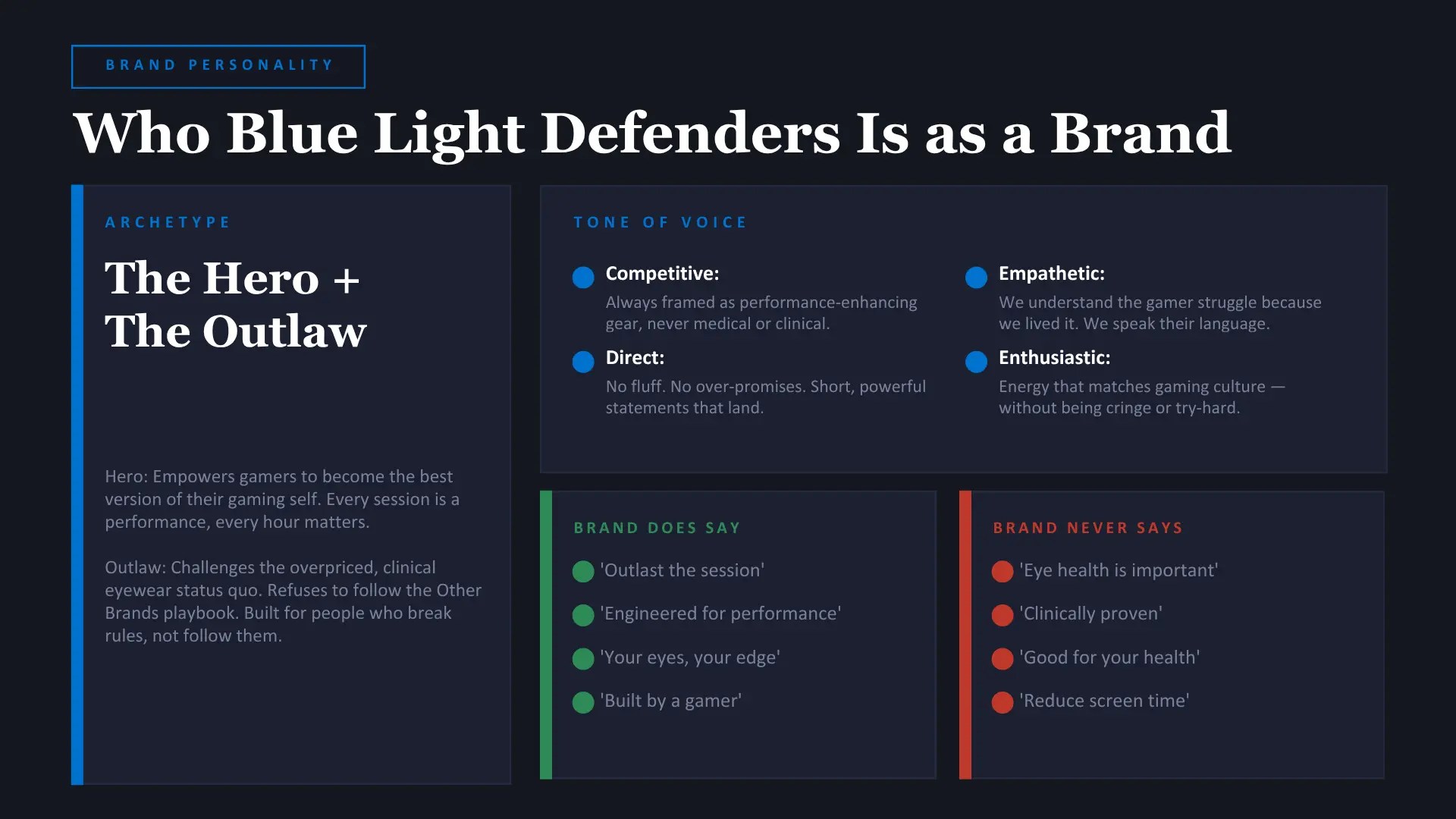
Two archetypes were identified as the dual personality of Blue Light Defenders, and the combination was not accidental. Archetypes are not aesthetic choices, they are behavioral frameworks that determine how a brand acts in every situation it encounters, from the tone of a customer service response to the energy of a product launch campaign.
The Hero archetype positions the brand as an enabler of the customer’s potential. Every message is framed around the gamer becoming a better version of themselves, playing longer, performing more consistently, recovering faster. The brand does not position itself as the hero of the story. Jordan K. is the hero. Blue Light Defenders is the gear that helps him win. This distinction is subtle but critical; brands that make themselves the protagonist of their own marketing tend to repel the exact audiences they are trying to attract.
The Outlaw archetype challenges the established order. The premium eyewear market had built its credibility on clinical language, amber-tinted lenses, and price points that excluded the majority of potential customers. Blue Light Defenders was built to reject that template entirely, to be the brand that said the emperor’s new clothes were sixty-dollar amber glasses that turned your screen yellow, and that genuine performance protection did not need to cost that much or look that clinical. The Outlaw does not break rules for the sake of disruption. It breaks the specific rules that have been used to exploit the people it is trying to serve.
Messaging Framework
Four Pillars. Every Word Accountable to One of Them.
The messaging framework translates the positioning statement into language that creative teams, copywriters, and campaign managers can actually use. It does not tell people what to write; it tells them what every piece of writing needs to express, regardless of the format or channel it appears in. Four pillars were defined, each governing a different dimension of how the brand communicates.
Identity
Community
Performance
Access
The brand strategy established the rules. Every headline, every ad, every email, every keyword, every piece of copy written after this point existed in relation to these decisions. What follows is the record of how that strategy was executed across five channels simultaneously, and what the data showed when we measured how well the execution served the strategy it was built to express.
Website Strategy & UX
Designing a Website That Thinks Like a Conversion Tool
A website is not a brochure. A brochure exists to inform. A website exists to move people from unaware to curious, from curious to interested, from interested to convinced, from convinced to committed. Every page, every section, every element on a well-built e-commerce website is making an argument for the next action the visitor should take. The Blue Light Defenders website was designed with that principle governing every structural and copy decision from the ground up.
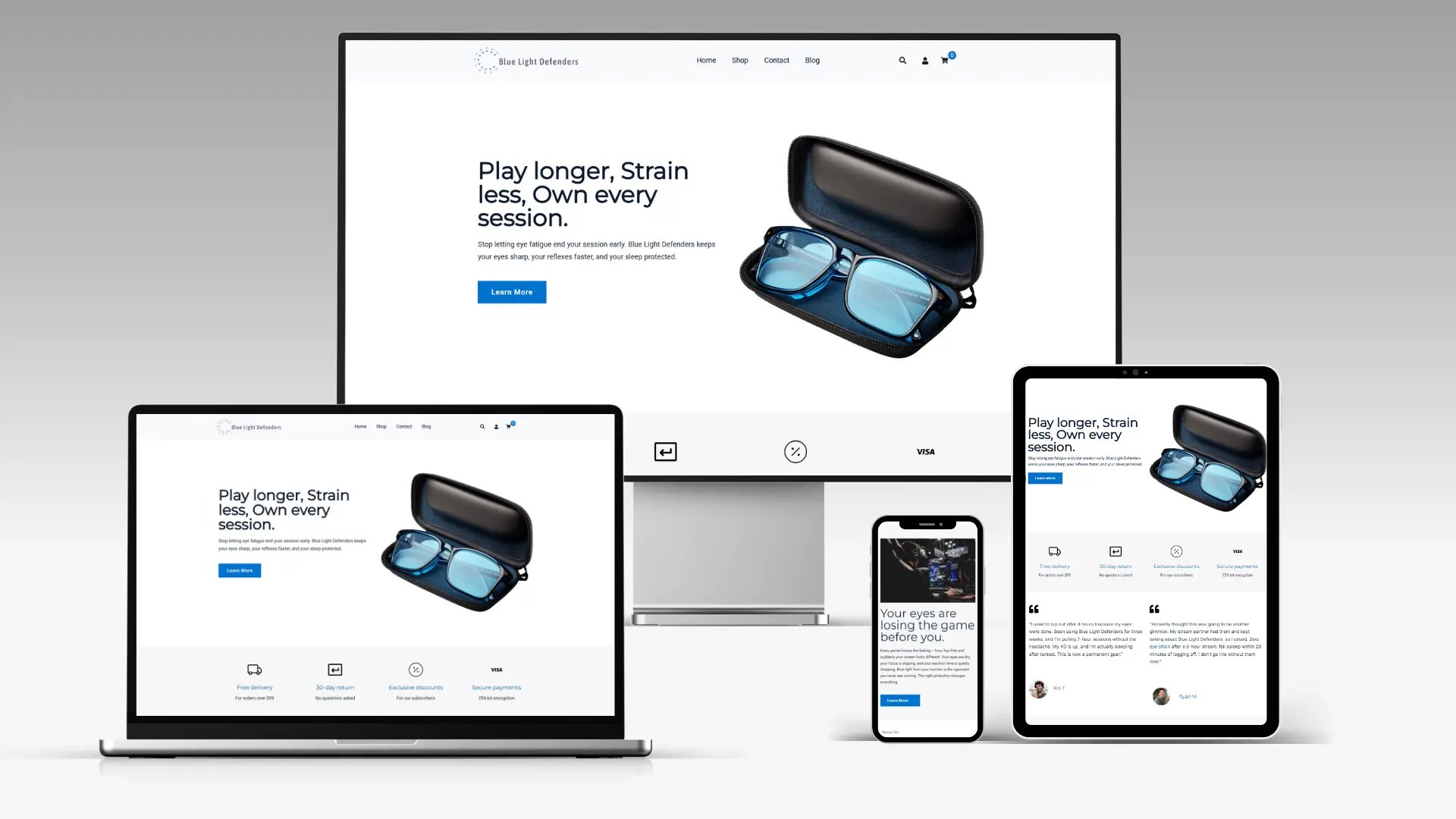
The site was built on WordPress with WooCommerce handling the e-commerce infrastructure. The architecture was kept deliberately simple, not because simplicity was the default, but because the target audience is task-oriented and impatient with friction. Jordan K. does not browse. He searches, evaluates, and decides. A site with twelve navigation items and five levels of sub-menus is a site that loses him before he reaches the product page. The navigation was reduced to four items: Home, Shop, Blog, and Contact. Each one has a specific role in the conversion journey. None of them exist because they seemed like good ideas.
Site Architecture
Every Page Has One Job
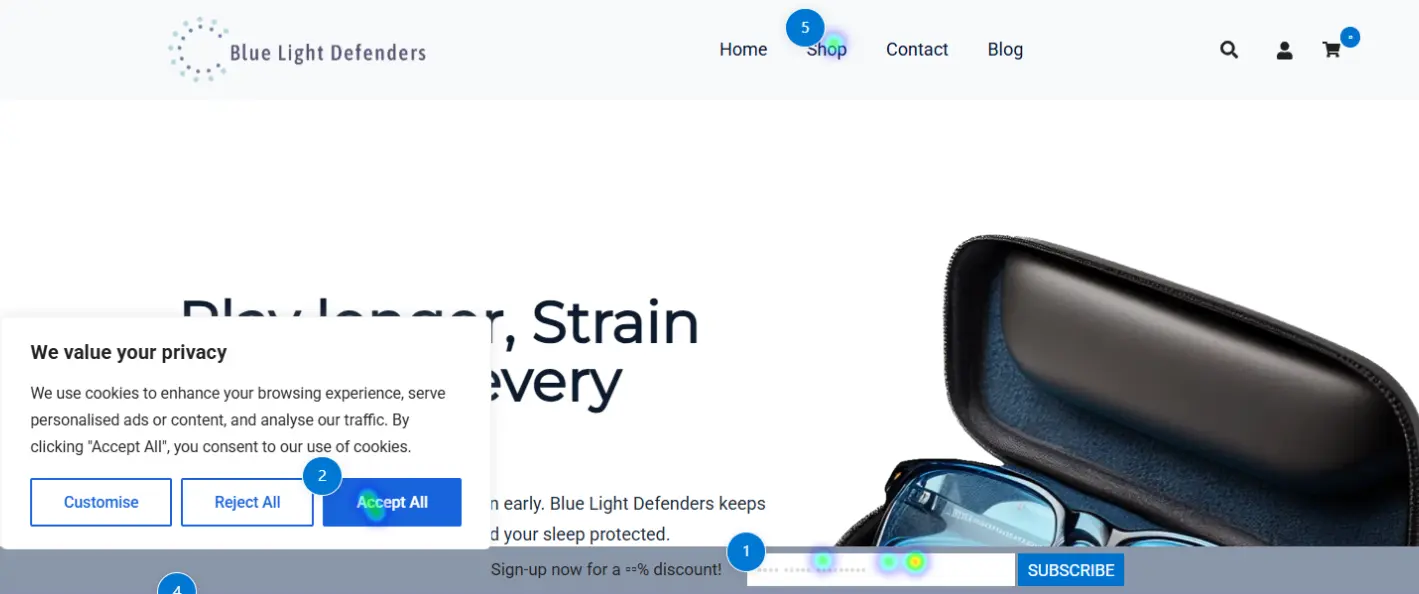
The homepage exists to establish the brand identity and capture email subscribers. A visitor who lands on the homepage for the first time should leave knowing exactly what Blue Light Defenders is, who it is for, and whether it is worth coming back to. The email capture positioned in the hero section with a discount incentive rather than in the footer where most sites bury it, treats subscriber acquisition as a primary business objective rather than a secondary consideration.
The shop page presents the full product catalog and functions as the commercial hub of the site. Its design prioritizes product imagery and clear pricing over editorial content, because a visitor who navigates to the shop page has already passed the awareness stage. They are in evaluation mode. The shop page respects that by giving them the information they need to compare and decide without making them work for it.
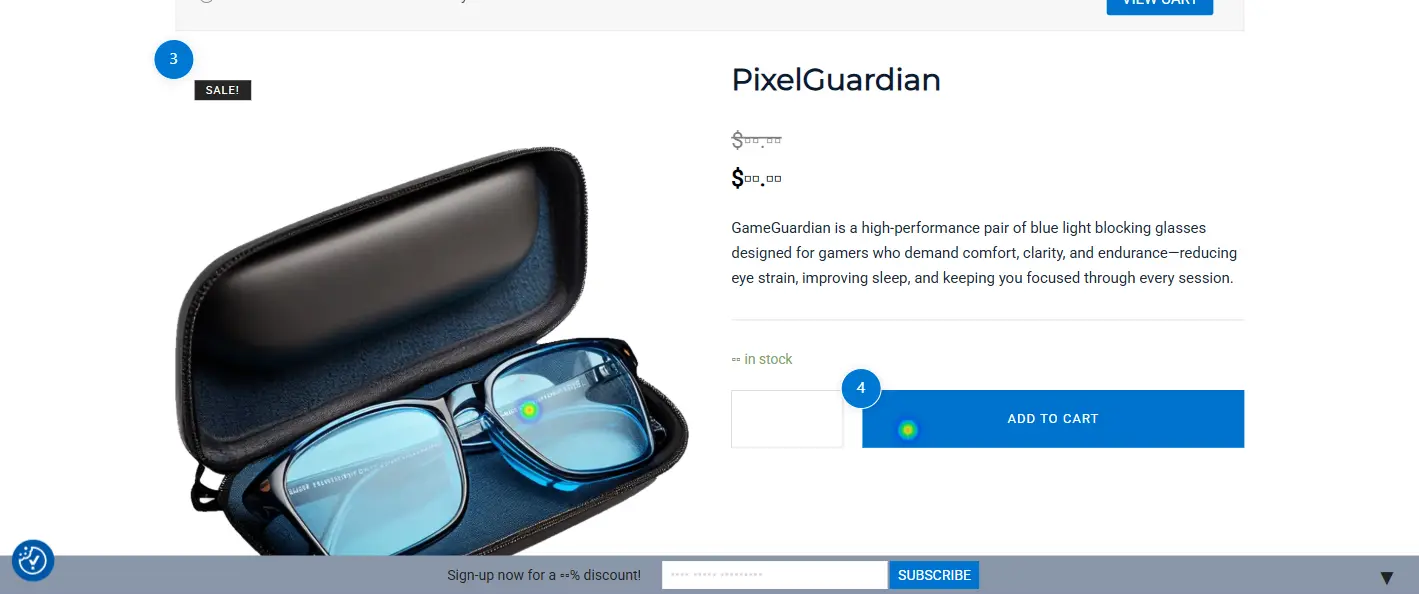
The PixelGuardian product page is the primary conversion destination, the page where interest becomes purchase intent and purchase intent becomes a transaction. It was structured in the sequence that e-commerce conversion data consistently supports: hero image and performance claim first, price and key benefit second, social proof third, primary CTA fourth, detailed specifications fifth. The sequence is not arbitrary. It mirrors the order in which a skeptical buyer naturally processes a purchase decision.
The blog serves as the organic search entry point for informational queries, visitors who are in the research phase of the buying journey and not yet ready to evaluate a product. Its purpose is not to generate direct conversions. Its purpose is to earn the trust of visitors who will return later, when they are ready, already predisposed to a brand that gave them something useful for free.
The contact page reduces pre-purchase friction. Research consistently shows that the visible presence of a contact option, even if the visitor never uses it, increases purchase confidence. It signals that a real operation is behind the website and that someone is reachable if something goes wrong.
UX Analysis — The Heat Map
Reading Visitor Attention Patterns
Understanding where visitors look, click, and engage on a page is not a post-launch luxury, it is a design input that should inform layout decisions from the earliest stages of development. Heat mapping is the most accessible tool for this kind of attention analysis, and it was applied to the Blue Light Defenders homepage hero section to evaluate whether the most strategically important elements were receiving the attention they needed to function effectively.
The analysis identified five primary hotspots on the hero section, areas of concentrated visitor engagement that revealed the natural reading and clicking patterns of incoming traffic. The headline and the primary CTA performed as expected, drawing the highest concentrations of attention. The email capture field showed strong engagement, validating the decision to position it within the hero rather than below the fold. The navigation items, particularly Shop, showed consistent engagement, suggesting that a meaningful proportion of visitors arrived with enough prior awareness to navigate directly to the product catalog rather than reading the homepage content sequentially.
This heat map analysis was conducted as a UX methodology exercise demonstrating the ability to design, apply, and interpret attention pattern data using standard industry tools such as Hotjar and Crazy Egg. It forms part of the portfolio demonstration of UX analysis capability.
Trust Infrastructure
The Elements Visitors Never Read But Always Notice
A professional e-commerce website is not complete without the legal and policy infrastructure that signals to visitors, consciously or not, that a real operation is behind it. Three documents were developed and published as part of the Blue Light Defenders website build: a Terms and Conditions document covering product accuracy, availability, pricing, payment, and health disclaimers; a Privacy Policy compliant with GDPR principles, detailing data collection, legal bases for processing, retention periods, and third-party processors; and a Returns and Refunds Policy establishing a thirty-day return window, the conditions for return eligibility, and the refund processing timeline. These documents are not marketing assets. They are the foundation of purchase confidence, the quiet signals that tell a visitor this brand is accountable, organized, and safe to buy from.
Building the website created the destination. The next challenge was making sure the right people could find it, specifically, the people who were already searching for exactly what Blue Light Defenders offered, at the exact moment they were searching. That is the work the SEO strategy was built to do.
SEO Strategy
Getting Found by the Right Person at the Right Moment
Search engine optimization was approached as an audience intent problem before it was approached as a technical one. The question that governed the SEO strategy was not “which keywords have the highest search volume?” it was “what is Jordan K. typing into Google at each stage of his journey from someone who has never heard of blue light glasses to someone who is ready to buy a specific pair?” Those are different questions, and they produce fundamentally different strategies.
The answer to the second question revealed three distinct search intent stages, each requiring a different type of content, a different page structure, and a different definition of success. A visitor at the informational stage needs education. A visitor at the commercial stage needs comparison. A visitor at the transactional stage needs clarity and confidence. Treating all three stages with the same content as many e-commerce sites do, optimizing only their product pages and leaving the rest of the funnel unaddressed means winning the attention of people who are ready to buy while abandoning everyone who is not ready yet but would have been, given the right content at the right moment.
The Three Intent Stages
The Same Audience, Three Different Conversations
Informational Intent:
At the informational stage, the searcher has a problem but no solution in mind. They are searching for things like “why do my eyes hurt after gaming” or “benefits of blue light glasses for gamers.” They are not close to a purchase decision. They are in the earliest stage of awareness becoming conscious of a problem they have probably been experiencing for months without naming it. The content that serves this visitor needs to be genuinely useful, not promotional. It needs to answer the question they actually asked, earn their trust, and introduce the brand as a credible voice in this space not as a seller trying to convert them before they are ready.
The Blue Light Defenders blog post “The Benefits of Blue Light Blocking Glasses Every Gamer Should Know About” was built to serve this visitor. Optimized for the focus keyphrase “benefits of blue light glasses,” the post was designed to rank for informational queries and begin the trust-building process with visitors who would return later, already familiar with the brand, when they were ready to evaluate products.
Commercial Intent:
At the commercial stage, the searcher knows solutions exist and is comparing them. They are searching things like “best gaming glasses for eye strain” or “blue light glasses for gamers review.” They have moved from problem-awareness to solution-awareness and are now evaluating options. Content that serves this visitor needs to be comparative, specific, and honest demonstrating how Blue Light Defenders addresses the specific objections and preferences that the audience research identified: price, lens clarity, gaming credibility, and community trust.
Transactional Intent:
At the transactional stage, the searcher is ready to buy. They are searching things like “buy blue light glasses” or “PixelGuardian glasses.” Friction is the enemy at this stage. The product page needs to answer every remaining objection: how much does it cost, what exactly do I get, what if it does not work, what do other people say about it, and then present a single, clear path to purchase. The PixelGuardian product page was optimized for this stage with the focus keyphrase “buy blue light glasses,” structured to move a high-intent visitor from arrival to checkout with the minimum number of decisions required.
On-Page Optimization
Three Pages, Three Different Conversations With Google
On-page SEO optimization was applied to three key pages, each targeting a different intent stage and therefore requiring a different optimization approach. What follows is not a checklist of technical SEO elements — it is a record of the strategic thinking behind each optimization decision.
Focus Keyphrase: Blue Light Defenders
Focus Keyphrase: benefits of blue light glasses
Focus Keyphrase: buy blue light glasses
Keyword Research
Building the Keyword Map
The keyword research was conducted using Google’s Performance Planner forecasting tool, which was used to project impressions, click-through rates, estimated clicks, and cost-per-click for twenty-one keywords across the campaign. Keywords were selected against two criteria applied simultaneously: audience relevance does this represent a query Jordan K. would actually make at some point in his decision journey? and commercial viability does the intent behind this query represent someone who is moving toward a purchase decision?
The highest-priority keywords identified were “blue light glasses for gaming,” projected at one hundred thousand monthly impressions with a one percent click-through rate and “amber lens gaming glasses,” projected at forty thousand impressions with a one-point-two-five percent click-through rate. The amber lens keyword is particularly significant strategically. A searcher typing “amber lens gaming glasses” is already aware of the product category and already using the specific lens type language that the competitive analysis identified as Blue Light Defenders’ primary differentiator. Capturing this searcher with content or advertising that offers a superior alternative clear lenses with equivalent protection represents a high-intent opportunity with a strong conversion narrative already built in.
Site Search Analysis
When SEO Data Becomes a Business Recommendation
The most valuable finding from the SEO research phase did not come from keyword planning. It came from analyzing what visitors were already searching for within the Blue Light Defenders website itself and finding a category of demand so large and so completely unaddressed that it crossed from being a marketing insight into being a product strategy recommendation.
The internal site search data revealed over twenty-four thousand six hundred monthly searches in a single category, ergonomic gaming accessories for which no product existed on the site. Visitors were searching for things like “gaming chair ergonomic setup,” “wrist rest gaming,” “ergonomic gaming desk accessories,” “posture corrector gamer,” and “neck support gaming chair.” They were arriving on the Blue Light Defenders site already inside the brand’s ecosystem, already engaged enough to use the search function and finding nothing. Every one of those twenty-four thousand six hundred monthly searches ended on an empty results page.
In isolation, this is a UX problem. In context, it is a revenue opportunity. The data revealed that a meaningful segment of the Blue Light Defenders audience people who had already found the site and were already interested in the brand had a second purchase need that the brand was currently unable to serve. Launching ergonomic gaming accessories as a fourth product category would not require finding a new audience. It would require building a product for an audience that had already found you and was already asking for it.
This is what distinguishes SEO analysis from SEO reporting. Reporting tells you what happened. Analysis tells you what it means and what to do about it. The site search gap data was not included in the final strategy documentation as an interesting observation. It was included as a formal recommendation: launch ergonomic accessories as a fourth product category in the next planning cycle, beginning with the three to four highest-volume search terms as the initial product selection guide.
SEO builds the path between a searcher and a brand. But a visitor who arrives on the site once and leaves without converting represents an incomplete relationship one that required significant effort to initiate and produced no return. Email marketing was built to solve that problem: to create a channel that could follow up, nurture, and convert the visitors that organic search brought to the door but did not yet bring through it.
Email Marketing
Building a Relationship System, Not a Broadcast Channel
The email marketing strategy for Blue Light Defenders was not built around the question of what to send. It was built around a more fundamental question: what does someone need to hear, and in what order, to move from a visitor who found the site interesting to a customer who trusts the brand enough to spend money with it? That question about sequence, about timing, about the specific emotional and rational milestones a new prospect needs to pass through before buying is what separates an email program that works from one that generates unsubscribes and spam reports.
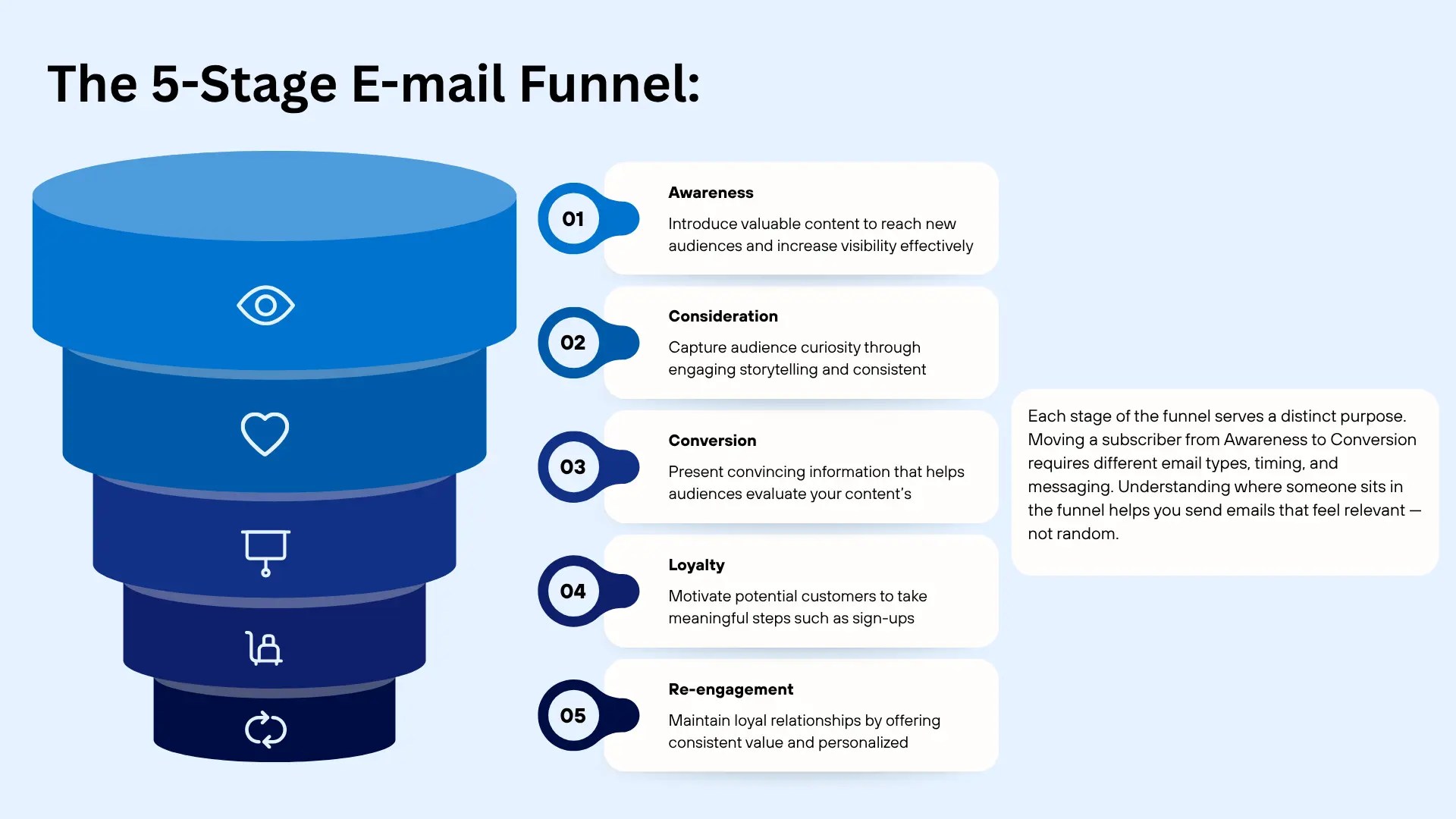
The program was structured in five stages that mirror the natural progression of a new customer relationship: acquisition, where the goal is to earn the email address; nurture, where the goal is to earn the trust; conversion, where the goal is to earn the purchase; retention, where the goal is to earn the repeat purchase; and recovery, where the goal is to earn back the customers who drifted away. Every email template, every SMART goal, and every segmentation decision in this project was positioned within one of those five stages. Nothing was created without a clearly defined role in the broader system.
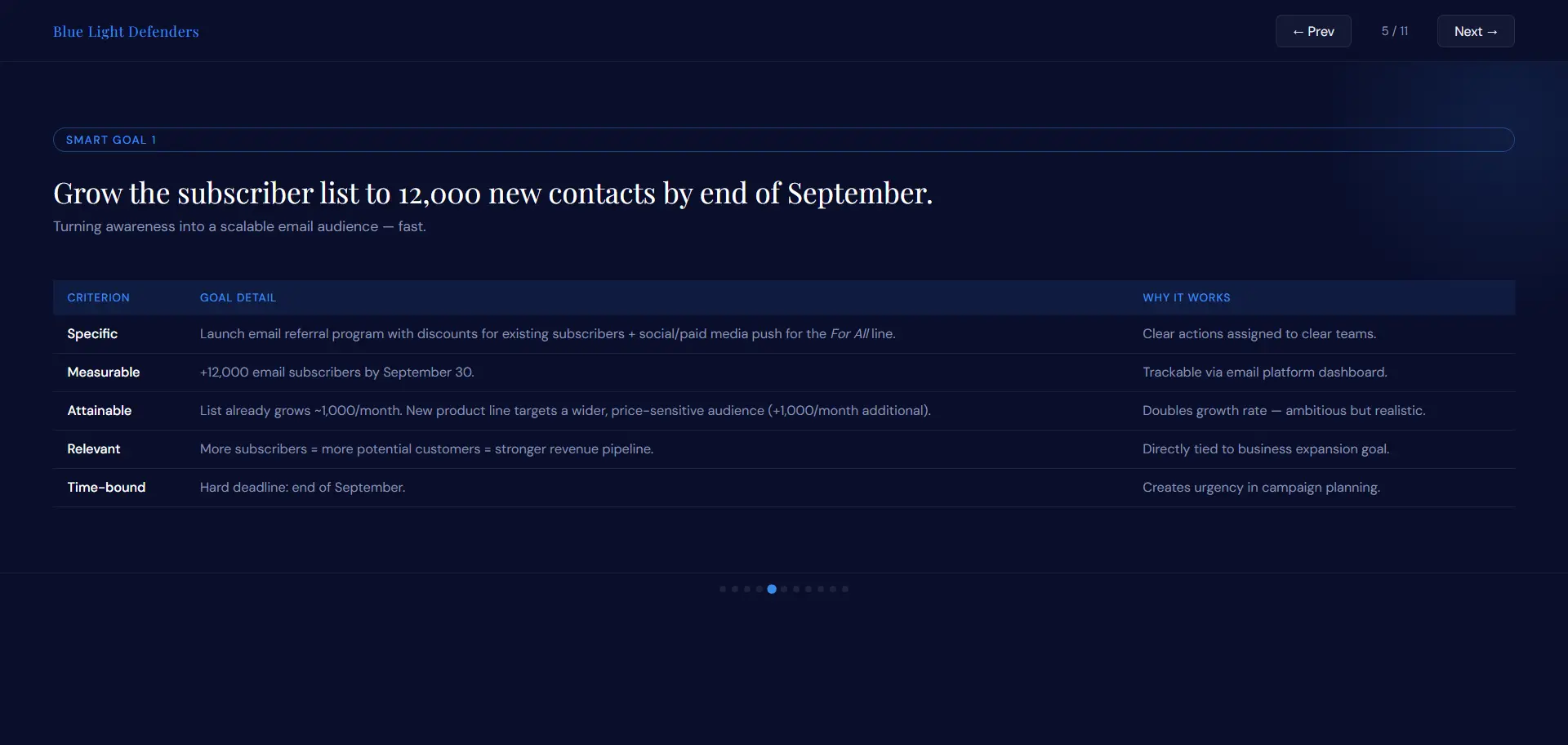
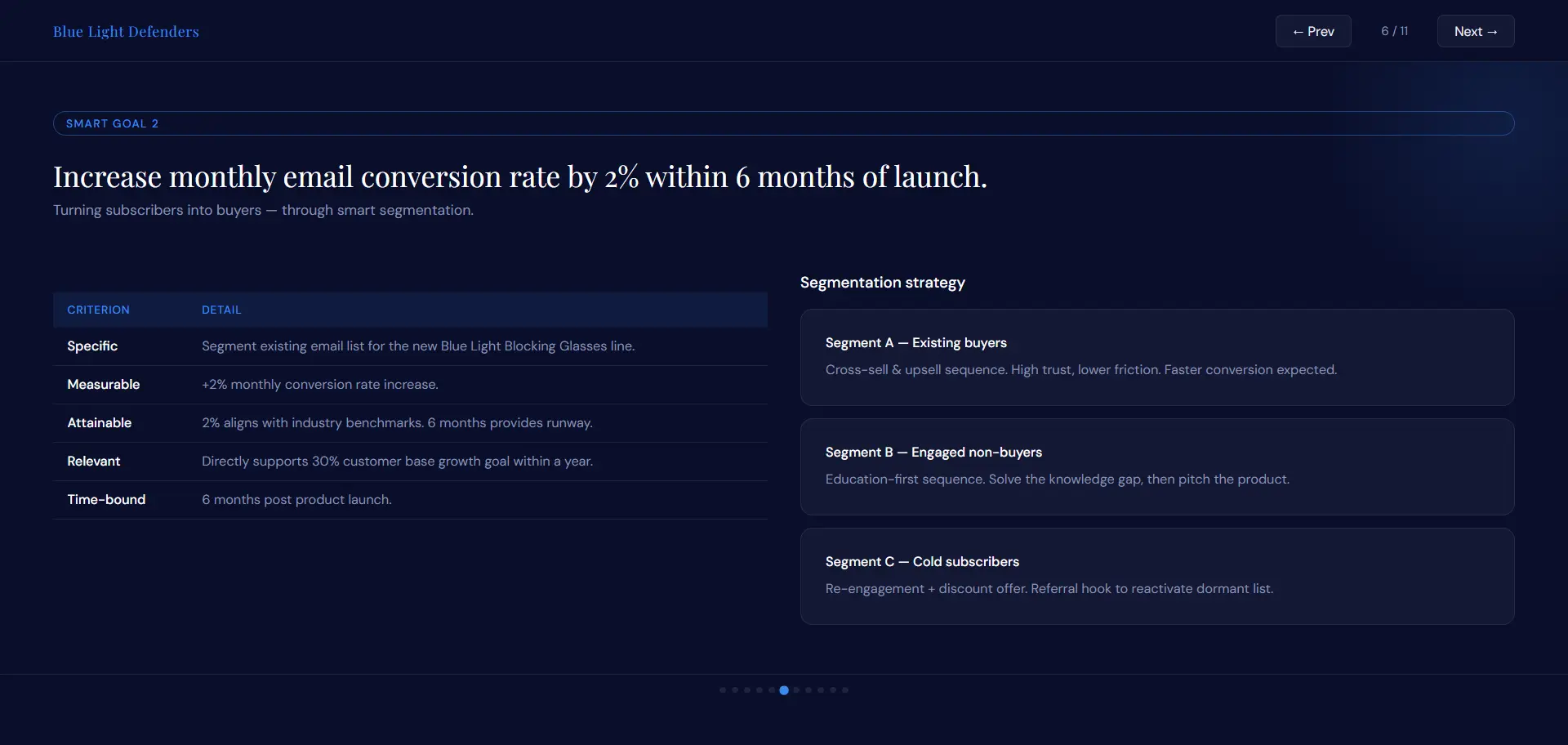
The SMART Goals
Two Goals. Every Decision Accountable to One of Them.
Before a single email was written or a single template designed, two SMART goals were defined to govern the entire program. Goals in email marketing are not aspirations; they are constraints. They determine what gets built, what gets measured, and what constitutes success or failure. Without them, an email program becomes a series of campaigns that feel productive but cannot be evaluated against anything meaningful.
Goal One: List Growth
Goal Two: Conversion Rate
Segmentation Strategy
The Right Message Requires Knowing Who Is Reading It
Sending the same email to every subscriber on a list is not email marketing it is email broadcasting. The distinction matters because the people on an email list are not a homogeneous group. Some have already bought. Some have visited the product page multiple times without purchasing. Some signed up months ago and have not opened a single email since. Each of those groups has a different relationship with the brand, a different level of trust, a different proximity to a purchase decision, and therefore a different email that will serve them well. Segmentation is the practice of acknowledging those differences and responding to them deliberately.
Cold Subscribers
Existing Buyers
Engaged Non-Buyers
The Five-Email Nurture Sequence
A Fourteen-Day Journey From Stranger to Customer
The nurture sequence is the operational heart of the email program the automated series of emails that a new subscriber receives in the days following their sign-up, designed to move them from initial curiosity through informed consideration to confident purchase intent. The sequence was built on a principle that most email programs violate: each email has exactly one job. The moment an email tries to educate, sell, build trust, and create urgency simultaneously, it accomplishes none of those things clearly enough to move the subscriber forward.
Consumer Psychology
The Science Behind Why the Emails Work
Every email in the nurture sequence was engineered around psychological principles that govern how people make decisions when encountering an unfamiliar brand for the first time. These are not manipulation tactics; they are an acknowledgment that human decision-making follows predictable patterns, and that marketing that understands those patterns is more effective than marketing that ignores them. Six principles were applied across the sequence.
Social Proof
Urgency and Scarcity
Reciprocity
Price Anchoring
Loss Aversion
Authority and Science
Creative Execution
Ten Templates. Five Campaign Categories. One Consistent Voice.
The email strategy was brought to life across ten designed templates spanning the full lifecycle of a customer relationship. Each template was built in a real email service provider Mailchimp, for the content-led sequences, and Hostinger Reach for the promotional and retention campaigns, and was designed to be consistent with the visual identity established in the brand strategy while serving the specific behavioral objective of its campaign category.
Performance Analysis Exercise
Translating Campaign Data Into Business Insight
The following performance analysis was conducted as a simulated campaign exercise using projected figures to practice email performance reporting and stakeholder communication skills. The figures below represent a modeled scenario, not verified campaign results.
As part of the email marketing practice component of this project, a complete end-of-campaign performance analysis was conducted using a simulated August campaign scenario. The exercise was designed to develop and demonstrate three specific skills: reading email performance metrics at the campaign level, calculating the business value of email as a revenue channel, and producing the kind of stakeholder report that a marketing team lead or client would actually use to make decisions.
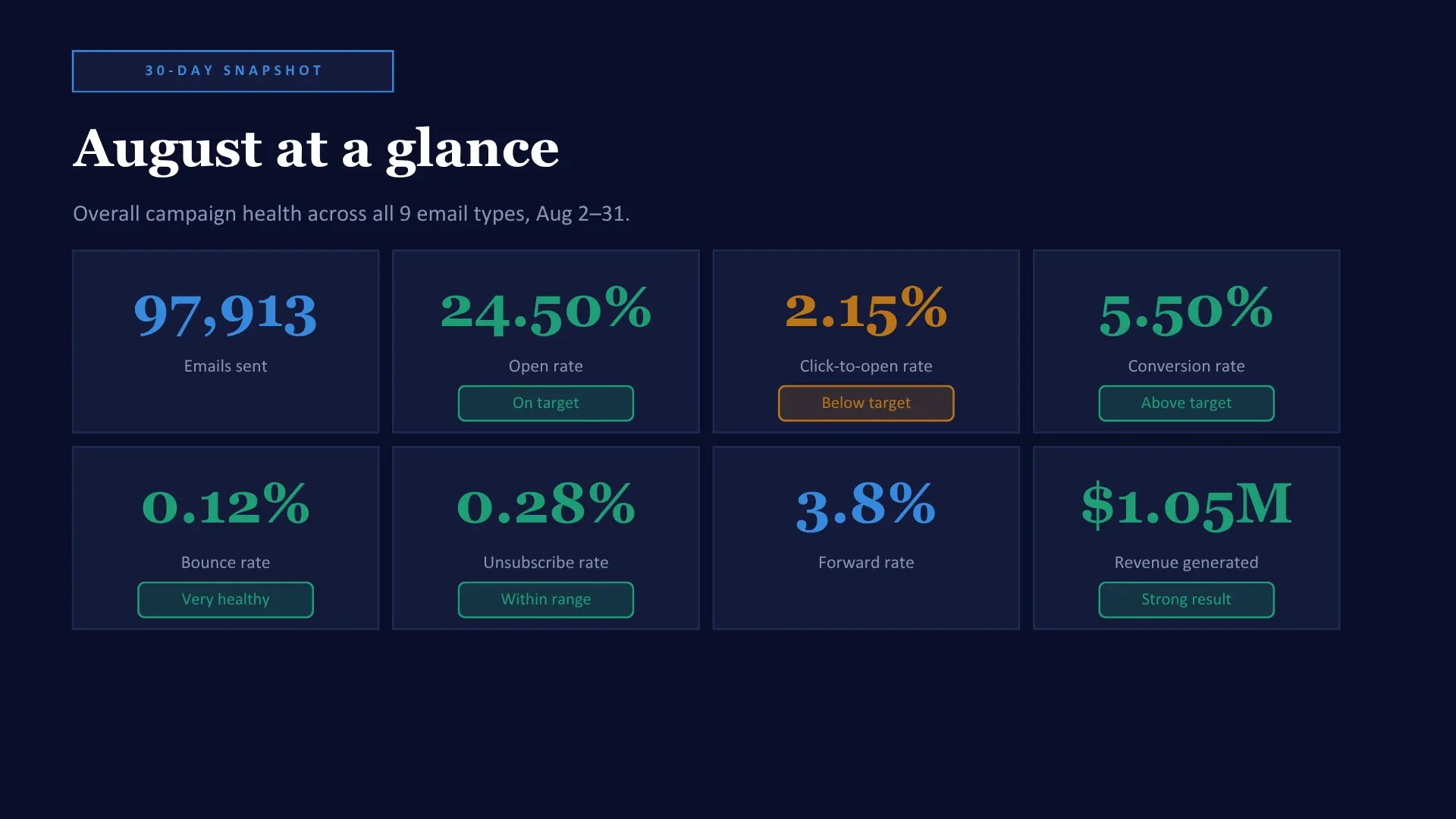
The August scenario was structured to practice the analytical questions that matter most in email performance review: what was the revenue per email, how does that compare to the cost of the campaign, what does the conversion rate imply about list health and segmentation effectiveness, and which segments or email types drove a disproportionate share of the revenue? The ability to answer those questions from a campaign data set and to communicate the answers in a format that a CEO, a client, or a non-marketing stakeholder can act on is the skill the exercise was built to develop.
Email marketing converts the audience that organic search, SEO, and the website have already found. But for every person who found Blue Light Defenders through a search result or an organic referral, there were thousands more who had the same problem, the same audience profile, and the same purchase potential, and had never encountered the brand at all. Paid advertising was built to reach them.
Paid Advertising
Reaching the Audience That Has Not Found You Yet
The paid advertising strategy for Blue Light Defenders was built around a clear division of labor between two channel types. Google Ads specifically Search and Shopping was assigned the role of capturing demand that already existed: the gamers who were actively searching for solutions to the eye strain problem they were experiencing and were ready to evaluate specific products. Social media advertising across Instagram, Facebook, and TikTok was assigned the role of creating demand where it did not yet exist: reaching gamers who had the problem but had not yet connected it to a product solution, and making that connection through creative that felt native to their environment rather than intrusive within it.
The budget governing this strategy was one thousand dollars per month a deliberately constrained figure that required every channel and every campaign to earn its allocation by demonstrating clear role clarity and measurable contribution to the campaign’s two primary goals. Constraint in media planning is not a disadvantage. It is a discipline that forces the kind of prioritization and specificity that larger budgets often allow practitioners to avoid.
Google Search Ads
Capturing Intent at the Moment It Exists
The Google Search campaign was structured around a twenty-one-keyword list developed through Google’s Performance Planner forecasting tool, organized by intent level from broad awareness terms through to high-intent purchase queries. The campaign was named “Blue Light Defenders Search” and divided into ad groups that clustered semantically related keywords together a standard best practice that allows ad copy to be written with the specificity that Quality Score rewards and that genuine relevance requires.
The keyword selection logic was not simply about finding the highest-volume terms. It was about mapping the keyword list to the three intent stages established in the SEO strategy ensuring that the paid campaign was working in alignment with the organic strategy rather than duplicating it. High-volume informational terms like “blue light glasses” were assigned lower bid priorities because clicks from informational intent convert at significantly lower rates than clicks from transactional intent. High-intent transactional terms like “buy blue light glasses gaming” and “shop gaming glasses” received the highest bid priorities because a searcher using those exact phrases has already completed their research and is in the decision phase.
The ad format used throughout the campaign was Responsive Search Ads the current Google standard that provides up to fifteen headlines and four descriptions, allowing Google’s machine learning to test combinations and surface the highest-performing variants over time. The RSA format was chosen not because it is the default but because it provides genuine optimization value in campaigns where the brand is still building performance data: rather than committing to a single static ad, the RSA approach lets the data determine which combinations of headlines and descriptions produce the strongest click-through and conversion rates, and then serves those combinations more frequently as confidence builds.
Six optimization recommendations were reviewed against the campaign structure, each assessed against three criteria: whether it would change budget or strategy, whether it required prior approval, and whether its potential impact justified the implementation effort. Of the six, two were applied immediately, adding sitelink extensions to increase ad prominence and enabling optimized ad rotation to allow performance data to determine ad serving priority. Two were planned for implementation pending approval raising the daily budget to prevent ads from stopping on high-traffic days, and transitioning from manual to automated bidding using a Target CPA strategy. One was dismissed the recommendation to switch to Maximize Conversion Value bidding because the campaign was not yet generating enough conversion data for a value-based bidding strategy to optimize meaningfully. This kind of structured recommendation review is standard professional practice and reflects the reality that not every platform suggestion should be followed blindly.
A/B Testing
A Structured Experiment
One of the most valuable skills in paid advertising management is the ability to design a valid test to form a specific hypothesis, isolate a single variable, define the success metric before the test runs, and interpret the results without confounding factors. The following A/B test was designed to answer a specific strategic question that the audience research had raised but not resolved: does this audience respond better to protection-focused messaging or to deals-focused messaging?
The test was designed but not run against live traffic, as this is a portfolio project rather than an active advertising account. The value demonstrated here is the methodology the ability to identify a testable hypothesis from audience research data, design a statistically valid experiment with an appropriate sample size and confidence threshold, and define success before the test begins rather than after the results are in. These are the same skills applied in every real-world A/B testing environment, and they transfer directly to any live account.
Holiday Campaign Planning
The Calendar That Thinks Like a Customer
Holiday advertising planning requires a level of strategic specificity that general campaign management does not. The holiday period, specifically the window from Thanksgiving through the first week of January, is not a uniform block of elevated consumer intent. It is a series of distinct behavioral moments, each with its own purchase psychology, its own competitive landscape, and its own optimal bid level. A media plan that treats the entire holiday window with a single elevated budget and a single set of bids will be significantly less efficient than one that adjusts to the specific dynamics of each week within it.
The holiday bid calendar was built using the previous year’s revenue-per-click data as the foundation for projecting optimal bid levels for each period. The underlying logic is straightforward: if a click is worth four dollars in revenue during a typical week and seven dollars in revenue during the second week of December because purchase intent has intensified as the holiday approaches then the maximum bid that can be justified on that click increases proportionally. A static bid strategy leaves money on the table during high-intent periods and wastes it during low-intent ones.
The resulting calendar recommended a twenty-five percent bid decrease during the Thanksgiving week when traffic is high but shopping intent is disrupted by travel and family commitments and maintained steady bids through Cyber Monday, when purchase intent rebounds sharply. From the second week of December, bids escalated progressively: seventy-five percent above baseline in week two, two-hundred-and-fifty percent in week three, and four-hundred-and-fifty percent in the final days before Christmas, when each click represented a visitor with maximum purchase urgency and minimum time to consider alternatives. The recommendation was to fund this escalation with a total holiday budget of twenty-three thousand dollars, identified through a spend-versus-ROAS curve analysis as the optimal investment level before diminishing returns began to significantly erode profitability.
Social Media Advertising
Two Seconds to Make Someone Stop Scrolling
Social media advertising operates under a constraint that search advertising does not: the viewer did not ask to see the ad. They are mid-scroll, mid-conversation, mid-video and the advertisement is an interruption. The measure of a good social ad is not whether it is technically well-constructed. It is whether it earns the two seconds of attention required to make the viewer feel glad they stopped.
Nine campaigns were planned across Instagram, Facebook, and TikTok for the July through August period, with a combined planned media budget of approximately three thousand three hundred dollars. The campaigns were organized across three audience types that correspond to different stages of the brand relationship: cold traffic audiences who have never encountered Blue Light Defenders before, lookalike audiences modeled from existing purchaser profiles, and retargeting audiences who have previously visited the site or engaged with an earlier ad. Each audience type received campaigns with a different objective, a different creative approach, and a different definition of success.
Retargeting
Cold Traffic
Lookalike Audiences
Each campaign in the plan was assigned a single objective either awareness, traffic, or conversion rather than attempting to serve multiple goals within one campaign. This is one of the most commonly violated principles in entry-level paid social management. A campaign that is simultaneously optimized for awareness and conversion will be optimized for neither the algorithm needs a clear signal about what action to optimize for, and a conflicted objective produces a conflicted result. A single objective per campaign is not a stylistic preference. It is a structural requirement for campaigns that produce coherent, interpretable performance data.
Performance Analysis
Reading the Data to Reallocate the Budget
The following performance analysis was conducted as an analytical exercise using industry-representative campaign data to practice multi-channel ROAS comparison, LTV-to-CAC assessment, and budget reallocation decision-making. The figures represent a modeled scenario, not verified campaign results from a live advertising account.
A multi-channel campaign analysis was conducted using a one-hundred-and-eighty-day campaign scenario spanning four paid channels: Google Search, Google Display, social media advertising, and Google Shopping. The analysis was designed to practice the specific decision-making process that a media strategist applies when reviewing cross-channel performance data: identifying which channels are producing returns that justify continued or increased investment, which channels are underperforming relative to their allocated budget, and how to reallocate spend between channels to improve overall campaign efficiency without reducing total output.
The analysis produced a clear finding and a specific recommendation. Social ads and shopping ads were significantly outperforming search and display on both ROAS and LTV-to-CAC ratio. The LTV-to-CAC ratios for search and display one-point-seven-two and one-point-seven-eight, respectively both fell below the two-to-one threshold that the analysis defined as the minimum level of profitability required for a channel to justify its budget allocation.
The recommendation that followed was specific rather than directional: reallocate thirty-seven thousand five hundred dollars from the Google Search budget, reducing it from one hundred and eighty-seven thousand five hundred dollars to one hundred and fifty thousand, and redirect that allocation to social advertising, increasing the social budget from fifteen thousand to fifty-two thousand five hundred dollars. The rationale was not simply that social had a higher ROAS. It was that social had both a higher ROAS and a higher LTV-to-CAC ratio, meaning each dollar spent was producing more revenue per conversion and more long-term value per customer acquired. Shopping ads were left at their current allocation because, while their ROAS was strong, their revenue generation was approximately twenty percent lower than social at the same spend level — suggesting that increasing the social budget would produce greater returns than increasing shopping.
A secondary finding from the analysis addressed landing page optimization. The percentage of new customers making purchases through the social and search channels thirteen-point-five-one percent and nineteen-point-seven-five percent, respectively was lower than through shopping ads, at twenty-three-point-one-six percent. This gap suggested that the landing pages receiving social and search traffic were not as well-matched to visitor intent as the product listing pages that shopping ads directed visitors to. The recommendation was to develop channel-specific landing pages for social and search campaigns pages designed to match the specific creative angle and audience expectation of the ad that preceded them, rather than directing all paid traffic to a generic product page.
Running campaigns across five channels simultaneously generates more data than any strategy document can anticipate. The gap between a campaign that runs and a campaign that improves is what happens between the data and the next decision the analytical process that turns numbers into understanding and understanding into action. That process is what the analytics section documents.
Analytics & Measurement
Turning Data Into Decisions
Data without interpretation is just noise. The work documented in this section is not about collecting metrics it is about the analytical process that transforms raw numbers into specific, actionable recommendations that improve campaign performance. Three distinct analytical exercises were conducted as part of this project: a GA4 platform navigation and reporting practice, a deep conversion rate optimization analysis using a large-scale session dataset, and a social media content experiment that tested a specific hypothesis about what drives engagement in the target audience.
Analytics Transparency Note
The Google Analytics 4 screenshots, dashboard data, and reporting work shown in this section use Google’s publicly available Merchandise Store demo property a real GA4 account made available by Google specifically for analytics education, skill development, and portfolio demonstration purposes. This is a standard industry practice used by marketing professionals at every experience level.
This data does not represent Blue Light Defenders’ website traffic, customer behavior, or campaign performance. What it demonstrates is the ability to navigate the GA4 interface, interpret acquisition, engagement, and monetization metrics, extract meaningful insights from real-world data structures, and communicate findings in a format that supports business decision-making. These skills are fully transferable to any client’s GA4 property.
GA4 Analytics Practice
Reading the Dashboard That Tells You What Is Actually Happening
Google Analytics 4 was configured as part of the Blue Light Defenders website setup and used throughout the project to practice the three core reporting areas that a digital marketing specialist must be able to interpret fluently: acquisition metrics, which tell you where your visitors are coming from; engagement metrics, which tell you what those visitors do once they arrive; and monetization metrics, which tell you how those behaviors translate into revenue.
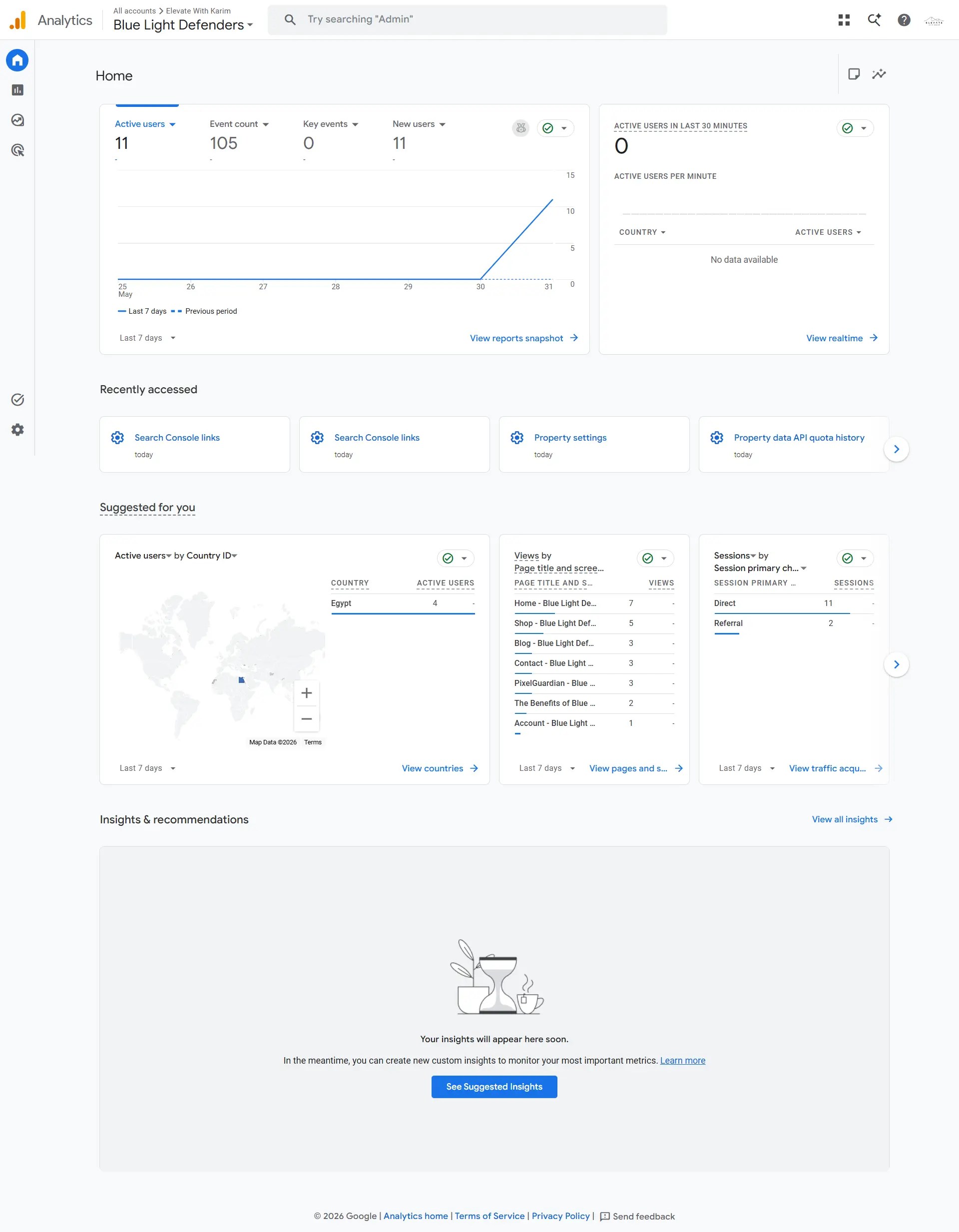
The GA4 home dashboard the first screen any analyst sees when checking campaign health, presents a real-time overview of active users, event counts, key events, new users, and a summary of the highest-traffic pages and primary traffic sources. Reading this dashboard correctly is not about recognizing the numbers. It is about knowing which numbers matter for which decisions, which anomalies warrant investigation, and which patterns suggest that something in the underlying campaign or website needs to change.
The dashboard shown above reveals several data points worth noting as examples of the interpretive process. The active users in the last thirty minutes fifteen at the time of the screenshot provide real-time traffic visibility that is most useful during active campaigns or promotional events, when traffic spikes or drops can indicate whether a campaign is serving correctly. The top pages by views Home, Shop, Blog, PixelGuardian, The Benefits of Blue Light Blocking Glasses reflect the intended content architecture of the site, with the homepage and shop page receiving the highest traffic and the blog post serving as the organic search entry point. The session sources Direct and Referral indicate the traffic mix at the time of the screenshot, which would normally prompt investigation into whether the referral sources are high-quality and whether direct traffic volume is consistent with brand awareness levels.
Conversion Rate Optimization
Not All Traffic Is Equal, And the Data Proved It
The most substantial analytics exercise in this project began with a question that sounds simple but has significant strategic implications: does the conversion rate of website visitors vary depending on when they arrive? If the answer is yes if visitors who arrive on a Tuesday afternoon convert at a measurably higher rate than visitors who arrive on a Saturday morning then the media budget allocation that treats all hours equally is wasting a significant proportion of its spend on the hours where it produces the fewest results.
To answer that question, a dataset of over one hundred and sixty-eight thousand sessions was analyzed, segmented by day of the week and hour of the day, with corresponding conversion rates recorded for each time block. The dataset covered every hour of every day across a full week one hundred and sixty-eight distinct time blocks allowing a complete picture of how conversion rate varied across the weekly cycle.
The finding was unambiguous and immediately actionable. Conversion rate varied dramatically across the week, not by a percentage point or two, but by factors of two to three times between the highest and lowest performing windows. The most striking illustration of this variance appeared in a direct comparison of two time blocks on the same day:
The afternoon block produced 23% fewer sessions but a 44% higher conversion rate and 11% more total conversions despite significantly lower traffic volume.
This comparison illustrates the core insight of the analysis with precision: more traffic does not mean more conversions. A media strategy that allocates its budget to maximize sessions chasing the hours with the highest visitor volume will systematically overspend on the hours where visitors are least likely to convert, while underspending on the hours where each visitor represents significantly higher purchase intent. The practical consequence of this misalignment is not a small inefficiency. It is a structural waste embedded in the campaign’s media schedule that compounds every day the schedule remains unchanged.
The full analysis identified two categories of time blocks across the complete weekly cycle. The first category, twenty hours distributed primarily across Monday, Tuesday, and Wednesday afternoons and evenings, showed conversion rates consistently above the dataset average, with several blocks reaching conversion rates between seventeen and twenty percent. These are the windows where visitors arrive with high purchase intent, lower comparison shopping behavior, and greater willingness to complete a transaction. The second category twenty-two hours distributed primarily across weekday early mornings, weekend early mornings, and specific midday blocks on Monday, Wednesday, and Friday showed high session volume but conversion rates significantly below the dataset average. These are the windows where traffic is abundant, but intent is low the digital equivalent of rush-hour footfall in a retail store where the majority of visitors are browsing rather than buying
Results
What the Campaign Produced, And What Was Actually Built
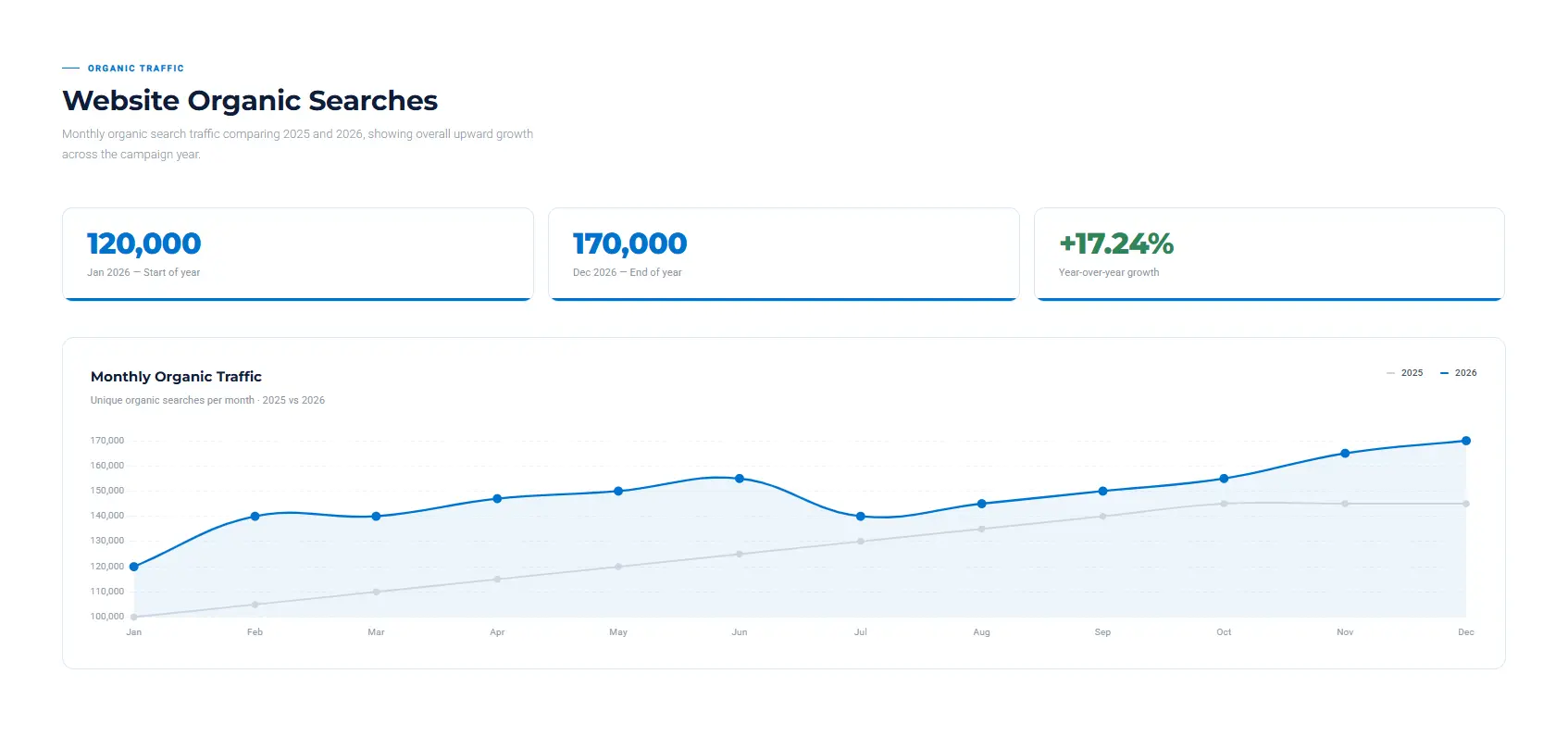
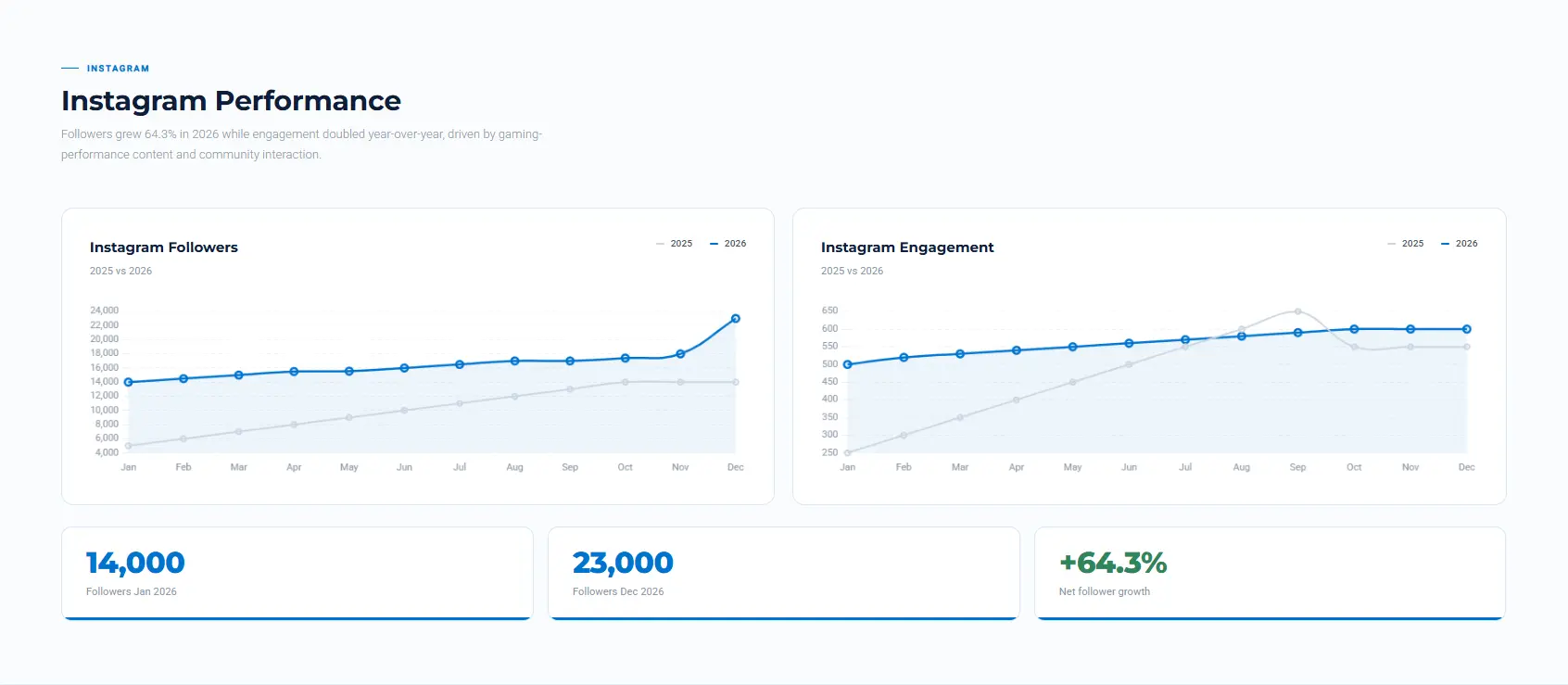
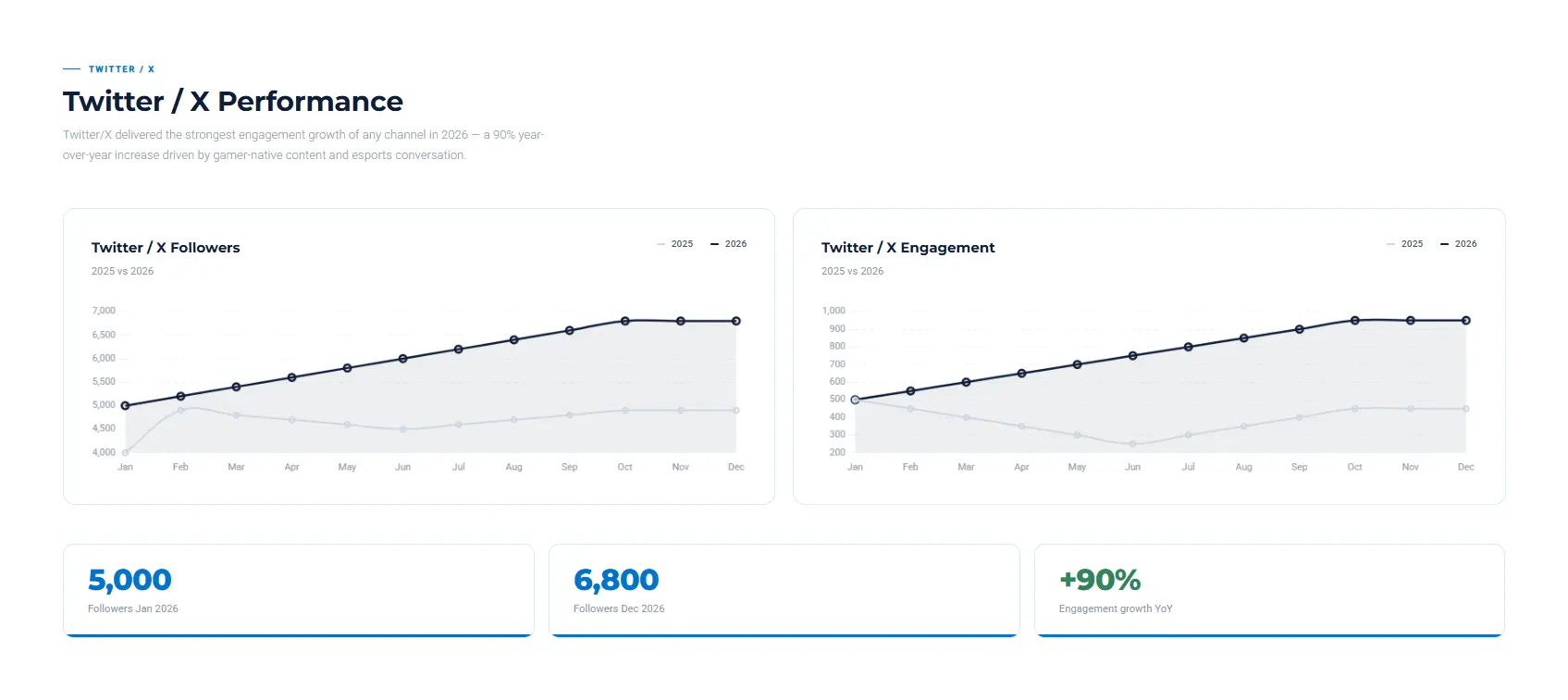
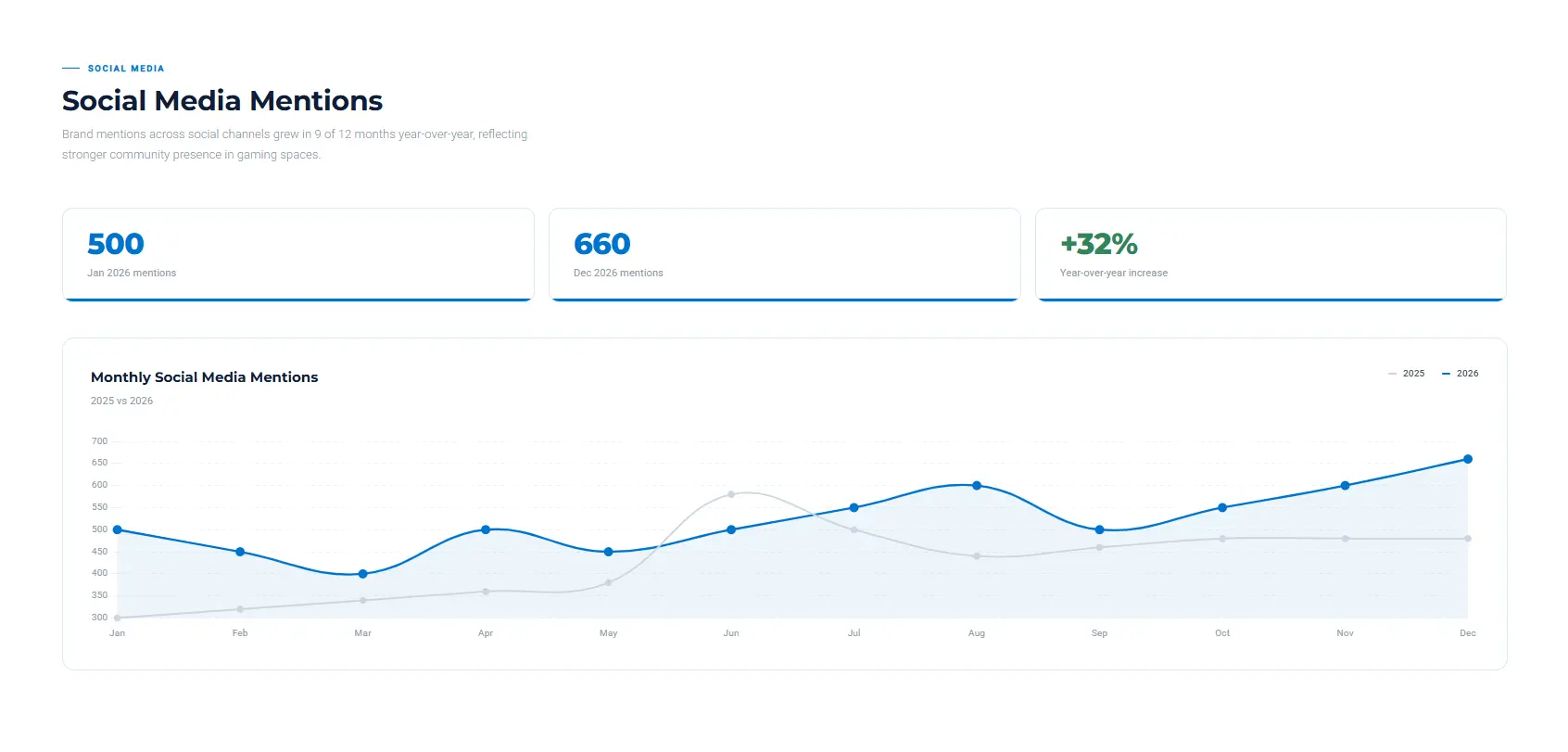
The results of the Blue Light Defenders campaign are presented in two tracks. The first track documents the simulated campaign model outcomes and the projected performance metrics that the twelve-month campaign strategy was designed to produce, modeled against real industry benchmarks and built to demonstrate goal-setting, performance forecasting, and marketing reporting skills. The second track documents what was genuinely delivered the real strategic, creative, and analytical work produced during this project, which constitutes the actual evidence of professional capability regardless of what any projection shows.
Both tracks matter. The first demonstrates the ability to project campaign outcomes, set measurable goals, and build reporting systems that hold a campaign accountable to its stated objectives. The second demonstrates the ability to research, plan, create, and analyze across the full scope of a digital marketing engagement. A hiring manager or client evaluating this case study will find both useful for different reasons, and they are presented together rather than separately because the honest picture of this project is one that includes both what was designed to happen and what was genuinely made.
Simulated Campaign Projections
The Twelve-Month Model — Goals Set and Measured
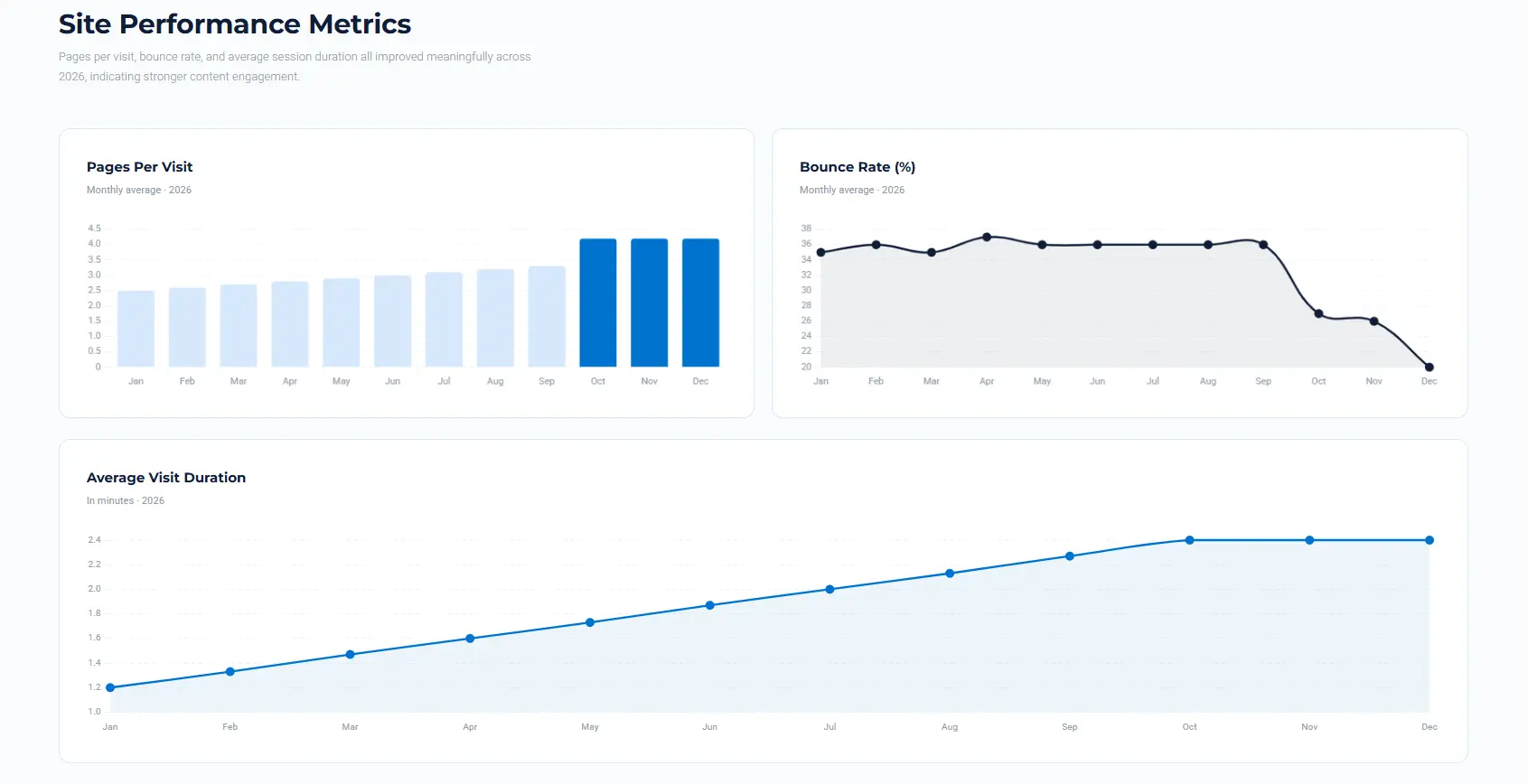
The metrics below represent a simulated twelve-month campaign model built to practice goal-setting, performance forecasting, and marketing reporting. They demonstrate the ability to project campaign outcomes and measure performance against defined objectives. They do not represent verified real-world campaign results.
At the outset of the project, two goals were defined: build brand awareness among performance-driven gamers aged twenty-three to thirty-three across five key markets, and increase holiday online sales by three percent. The campaign model was built to project how a disciplined, multi-channel strategy executed consistently over twelve months with a one-thousand-dollar monthly budget would perform against those two objectives. The following metrics represent the projected outcomes of that model.
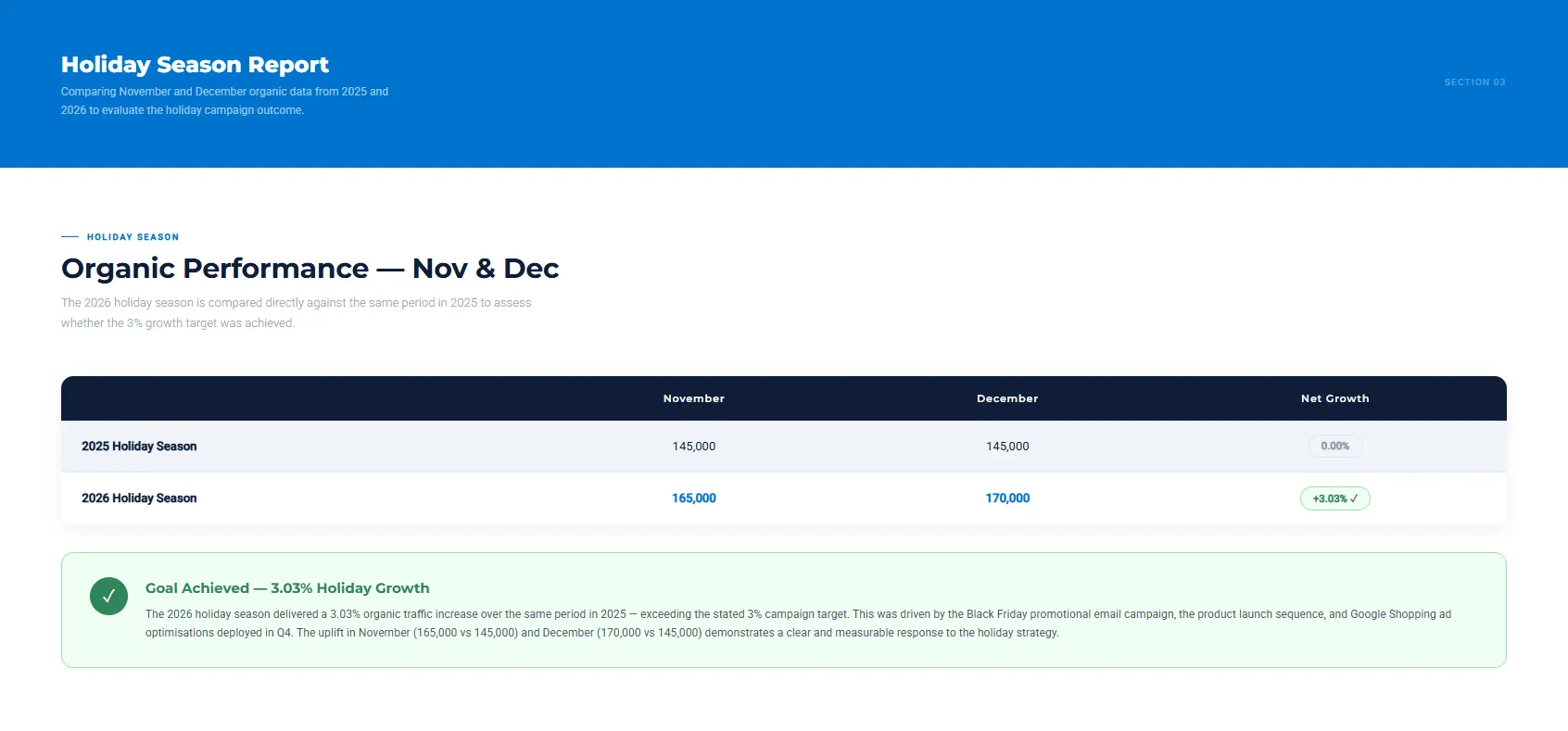
Genuine Deliverables
The Real Work — Every Deliverable Actually Produced
Beyond the campaign model, this project produced a substantial body of genuine strategic, creative, and analytical work using real professional tools. The following represents everything that was researched, planned, designed, built, or analyzed as part of this engagement the actual evidence of capability that exists independently of any projected performance figure.
Strategy and Research
The foundational strategy work produced four substantive research and planning documents: a four-competitor market analysis examining pricing, product range, content strategy, marketing approach, customer service policies, brand tone, and visual identity across GUNNAR, Gamer Advantage, and BlockBlueLight; a complete customer persona built from behavioral research, media consumption analysis, and gaming community observation; a social listening synthesis covering Reddit, Discord, X, and YouTube gaming communities; and a brand strategy document encompassing a positioning statement, Hero and Outlaw archetype definition, four-pillar messaging framework, does and does not say vocabulary list, and visual identity direction covering color, typography, and aesthetic principles.
Website and SEO
A complete WordPress e-commerce website was designed and built with five core pages: Home, Shop, PixelGuardian product page, Blog, and Contact, along with a full legal infrastructure including Terms and Conditions, Privacy Policy, and Returns and Refunds Policy. On-page SEO optimization was applied to three key pages, each targeting a distinct search intent stage, with documented title tags, meta descriptions, focus keyphrases, and URL structures. A site search analysis was conducted across sixty-plus internal search terms, producing a formal product expansion recommendation based on twenty-four thousand six hundred monthly unmatched searches in the ergonomic accessories category.
Email Marketing
The email marketing program produced six distinct deliverables: a two-SMART-goal framework with full SMART criteria documentation; an eleven-slide email marketing pitch deck covering the market problem, solution, audience segmentation, goal framework, campaign sequence, consumer psychology, list growth strategy, performance tracking system, and implementation roadmap; a three-segment audience architecture with tailored sequence logic for each segment; a five-email nurture sequence plan with day cadence, subject line direction, and behavioral objective for each email; a six-principle consumer psychology framework applied across the sequence; and ten email templates across five campaign categories awareness, consideration, conversion, retention, and recovery designed and built in Mailchimp and Hostinger Reach.
Paid Advertising
The paid advertising deliverables included a twenty-one-keyword Google Ads campaign structure with Performance Planner projections, organized across four ad groups with Responsive Search Ad frameworks; a structured A/B test design for headline performance testing with documented hypothesis, sample size, primary metric, and confidence threshold; a holiday bid calendar covering the Thanksgiving through January window with specific bid adjustment percentages calibrated to projected revenue-per-click at each period; a nine-campaign social media advertising planner covering Instagram, Facebook, and TikTok with audience definitions, objectives, formats, and creative briefs for each campaign; and eight social media ad creatives designed to professional specifications in the brand’s visual identity.
Analytics and Reporting
The analytics work produced five deliverables: a complete GA4 navigation and reporting practice exercise covering acquisition, engagement, and monetization metric interpretation using the Google Merchandise Store demo property; a one-hundred-and-sixty-eight-thousand-session conversion rate analysis segmented by day and hour, identifying twenty peak conversion windows and twenty-two low-CVR windows and recommending a thirty-one percent reduction in wasted ad spend; an internal stakeholder communication translating the CVR findings into specific, actionable ad scheduling recommendations; a formal X social media content experiment with documented hypothesis, results, and strategic implications; and a multi-channel ROAS comparison with specific budget reallocation recommendations across four paid channels.
Reporting
Two formal reports were produced as final project deliverables: an eighteen-slide end-of-year marketing report covering the full twelve-month campaign period, including organic traffic analysis, social media performance, holiday season comparison, and forward recommendations; and an eight-slide CVR optimization campaign data report summarizing the session analysis methodology, key findings, peak window identification, and projected efficiency improvement.
Professional Deliverables
A case study that ends at the results is a record of what happened. A case study that continues into honest reflection is a demonstration of professional maturity the willingness to evaluate your own work with the same analytical rigor you applied to the campaign itself. The final section of this case study is that reflection: what the project confirmed, what it challenged, what it revealed as missing, and what it prepared me to do next.
Reflection & Lessons Learned
What the Project Confirmed, What It Challenged, and What Comes Next
Building Blue Light Defenders from research through results produced something that no classroom exercise or theoretical framework can produce: the specific, earned understanding of how the pieces of a digital marketing strategy connect to each other in practice. Not how they are supposed to connect in a textbook, but how each decision actually constrains and enables the decisions that follow it, how each channel creates dependencies on the others, and how the quality of the thinking at the beginning of a project determines the quality of the options available at the end of it. What follows is an honest account of what that process confirmed, what it challenged, and what it revealed as missing.
What the Project Confirmed
Three Things the Project Proved to Be True
Brand strategy is not a deliverable. It is a decision-making system.
The most valuable SEO insight was not about rankings. It was about a product gap.
Analytical findings are only as valuable as the communication that carries them.
What the Project Challenged
Three Assumptions the Project Forced Me to Revise
I underestimated how much channel strategy is audience strategy in disguise.
Content strategy deserved its own dedicated phase, not a subsection of SEO.
Measurement planning needs to happen before execution, not alongside it.
What I Would Do Differently
Three Specific Changes to the Project Approach
Build the content calendar before the website goes live.
Incorporate Discord and Twitch as formal channel strategy from day one.
Run at least one real campaign element with real budget, however small.
What the Data Recommends Next
Three Data-Backed Directions for the Next Phase
Three recommendations for the next phase of the Blue Light Defenders strategy emerge directly from the data produced during this project not from speculation, but from specific findings that pointed clearly toward unaddressed opportunities.
Launch Ergonomic Accessories as a Fourth Product Category
Formalize the Community Channel Strategy
Implement Ad Scheduling Based on CVR Analysis
Professional Development Statement
What This Project Prepared Me to Do
I built Blue Light Defenders to answer a question I kept encountering in my digital marketing education: can I operate across the full scope of a marketing engagement not as a specialist in one narrow discipline, but as someone who can think strategically at the beginning of a project and execute competently across every stage that follows? The answer this project produced is yes, with honest qualifications.
I can build a brand strategy from research rather than from intuition. I can translate positioning into a messaging framework and apply that framework consistently across five channels without losing coherence. I can plan paid campaigns with enough structural specificity that the media plan is genuinely implementable rather than aspirationally described. I can analyze a dataset of one hundred and sixty-eight thousand sessions, find the signal inside the noise, and write an email that a marketing team can act on the same day they receive it. I can design an email program that treats the subscriber’s attention as something to be earned through a sequence of genuine value exchanges rather than depleted through a sequence of promotional broadcasts.
What I cannot yet claim is the specific, irreplaceable knowledge that comes from running real campaigns with real budgets against real audiences and seeing what the data actually produces rather than what a planning tool projects. That knowledge is the next chapter. This project built the foundation for it the frameworks, the tools, the analytical habits, and the strategic vocabulary and the gap between this foundation and genuine professional capability is now a matter of application rather than understanding.
The transition from portfolio project to client work is not a learning curve. It is a context shift: the same thinking, the same tools, the same process, applied to a real brief with real stakes and real feedback loops. I am ready for that context shift. This case study is the evidence.